Flooring is one of the most personal choices in any remodel — and in Iowa, it’s also one of the most consequential. The state’s clay soil, extreme humidity swings, and deep frost line punish the wrong flooring in ways most generic guides never mention. This post breaks down how LVP, hardwood, and tile each perform in Central Iowa conditions and shows you exactly which option belongs in each room of your home.
TLDR: In Iowa, LVP wins most rooms because it handles moisture, subfloor flex, and muddy winters without complaint. Hardwood still earns its place in living rooms and formal spaces, but it needs HVAC humidity control to hold up. Tile is the undisputed pick for bathrooms and mudrooms — but Iowa’s clay soil makes subfloor prep non-negotiable. Read on for the room-by-room breakdown.
Your flooring has to survive Iowa. That’s a tougher job than it sounds. Between spring mud season, 20% relative humidity in winter, and 75%+ in summer, and freeze-thaw cycles that push foundations at least 42 inches deep, your subfloor is under constant stress. Get the flooring wrong, and you’re looking at cracked tile, warped hardwood, or a water-damaged basement.
The good news is that once you understand how Iowa’s climate affects each material, the right choice becomes clear. We’ll walk through all three options, where each one succeeds in Central Iowa homes, and what you need to know before installing anything.
Why Iowa Makes Flooring More Complicated
Iowa sits on some of the most clay-rich soil in the Midwest. Clay expands when wet and contracts when it dries out. That movement travels up through your foundation and into your subfloor — and anything rigid and bonded (like tile grout) will crack under that pressure over time.
Add the frost line. Iowa foundations must reach at least 42 inches deep because of freeze-thaw cycles, and the heave that comes with that seasonal movement puts real stress on below-grade slabs. And then there’s the basement moisture picture: 71.6% of Iowa homes test above the EPA radon action level, and the “stack effect” means about half of your first-floor air originates from the basement. Flooring that holds moisture below grade affects the whole house.
The right flooring choice in Iowa isn’t just about style — it’s about matching material to conditions.
LVP: Iowa’s Most Versatile Flooring Option
Luxury vinyl plank is 100% waterproof, scratch-resistant, and installs as a floating floor. That floating installation is key in Iowa. Because LVP isn’t bonded to the subfloor, it can absorb minor flex from clay soil movement without cracking. In Iowa basements, specifically, LVP is the only flooring that reliably handles below-grade moisture and the risk of frost heave.
Not all LVP is the same. Two core types matter here.
The table below shows how SPC and WPC LVP differ and where each belongs in a Central Iowa home.
| Feature | SPC (Stone Polymer Composite) | WPC (Wood Polymer Composite) |
|---|---|---|
| Core material | Limestone + PVC | Wood flour + PVC |
| Best rooms | Basements, kitchens, high-traffic areas | Bedrooms, living rooms, comfort areas |
| Feel underfoot | Firm, rigid | Softer, more cushioned |
| Iowa basement rating | Best choice | Not recommended below grade |
| Durability | Extremely high | High |
SPC is the smarter pick for Iowa basements and anywhere moisture is a factor. WPC works well in living areas where warmth underfoot matters, especially during Iowa winters.
Tip: For any household with pets or heavy foot traffic, look for a wear layer of at least 20 mil. That wear layer (the clear top coat on LVP) is what determines how long the floor actually lasts.
Cost runs $5 to $12 per square foot installed, depending on grade. Lifespan is 10 to 25 years,s with premium SPC lasting toward the higher end.
Hardwood: Beautiful, But Know Where It Belongs
Hardwood adds genuine resale value. According to the NAR Remodeling Impact Report, installing new hardwoods delivers about 118% ROI, and about 54% of buyers say they’d pay more for a home with it. In premium Central Iowa homes, appraisers still favor hardwood.
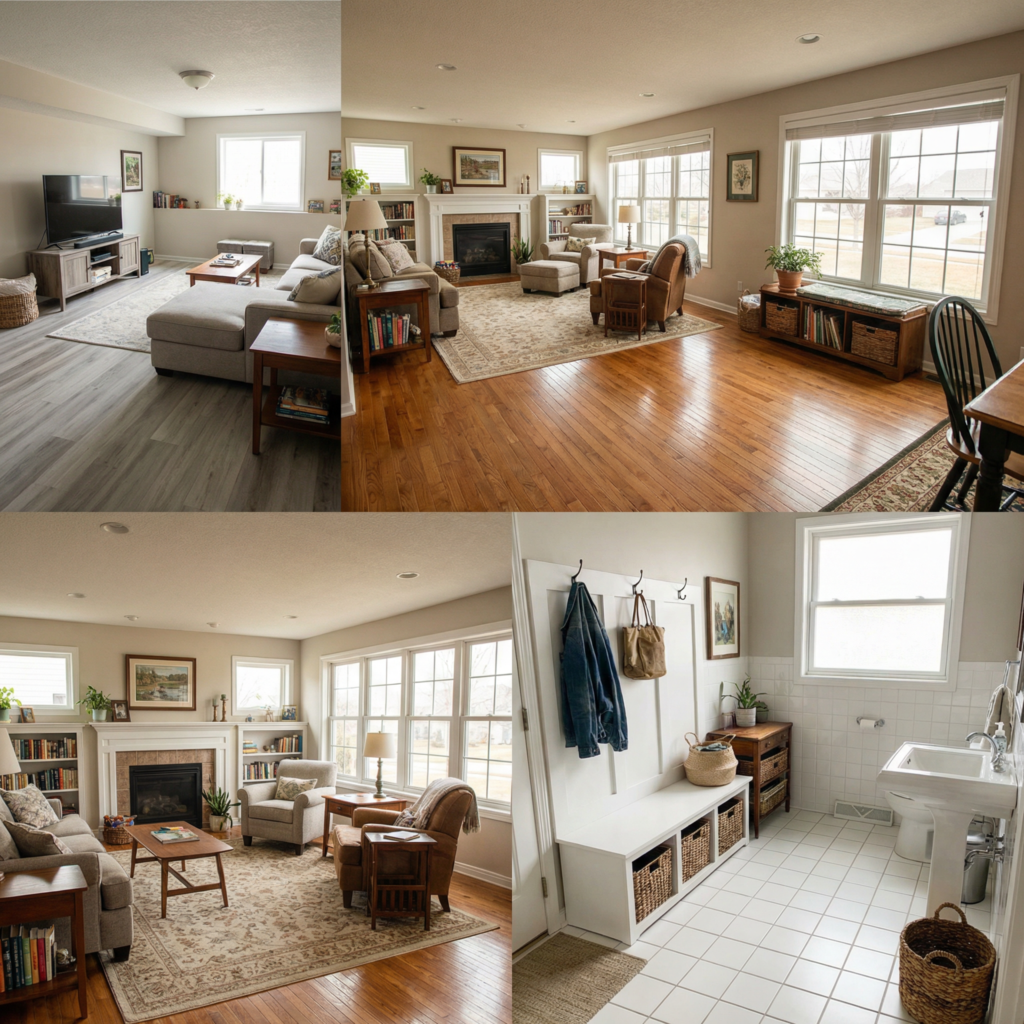
But Iowa’s humidity swings are the hardwood killer. Solid hardwood expands and contracts as humidity changes. In a Des Moines-area home, cycling between 20% RH in winter and 75%+ in summer, solid hardwood in the wrong location will cup, warp, and gap. The rule is simple: solid hardwood belongs in rooms with stable HVAC and no moisture risk.
Engineered hardwood handles Iowa’s climate better. Its cross-ply construction is about 50% more stable in response to humidity changes than solid wood, making it the smarter choice for living rooms and upstairs bedrooms. But engineered hardwood is still not waterproof — it doesn’t belong in basements or active-moisture kitchens.
The table below compares solid and engineered hardwood across the factors that matter most for Iowa homeowners.
| Feature | Solid Hardwood | Engineered Hardwood |
|---|---|---|
| Iowa humidity stability | Low — cups and warps | About 50% more stable |
| Iowa basement suitable | No | No |
| Refinish cycles | 5 to 7+ | 1 to 3 |
| Installed cost | $14 to $43/sqft | $11 to $23/sqft |
| Best Iowa rooms | Formal spaces with controlled HVAC | Living rooms, upstairs bedrooms |
Both types share one hard limit: neither belongs in an Iowa basement or any room with active moisture risk.
Tile: The Right Tool for the Right Room
Porcelain and ceramic tile are 100% waterproof and fireproof. They’re the clear winner for bathrooms, showers, and mudrooms. Tile also pairs better with radiant floor heating than any other material, according to the U.S. Department of Energy — it conducts heat efficiently and holds thermal mass well. In Iowa, radiant-heated tile in a mudroom or bathroom turns a cold-floor problem into a feature.
The challenge with tile in Iowa is the subfloor. Tile is rigid and bonded. When Iowa’s clay soil shifts beneath a slab — especially in a basement — tile grout cracks. Then the tiles crack. The repair cost often exceeds the original installation.
Illustrative scenario: An Urbandale homeowner had porcelain tile installed in their kitchen without addressing a soft spot in the subfloor. Within 18 months, the grout cracked along three lines as the subfloor continued to flex. The repair cost exceeded the original installation.
Important: If your Iowa subfloor shows any signs of movement, soft spots, or existing cracks, address those first. Tile over an unstable subfloor in a clay-soil zone will crack again.
Installed cost ranges from $12 to $50 per square foot, depending on the material, with ceramic on the lower end and premium porcelain on the higher end.
Iowa Room-by-Room Flooring Guide
Here’s a quick decision reference for the most common rooms in Central Iowa homes. Use this as your starting point before diving into specific products.
| Room | Best Choice | Second Option | Avoid |
|---|---|---|---|
| Basement | LVP (SPC core) | Nothing else below grade | Hardwood, tile |
| Bathroom | Porcelain tile | LVP | Solid hardwood, laminate |
| Kitchen | LVP or ceramic tile | Engineered hardwood | Solid hardwood |
| Mudroom / entry | Porcelain tile | LVP | Hardwood, carpet |
| Living room | Engineered hardwood | WPC LVP | Solid hardwood (without humidity control) |
| Bedroom | Engineered hardwood | WPC LVP | Tile (cold underfoot in Iowa winters) |
| Rental property | LVP (any room) | LVP | Hardwood, carpet |
The basement column is the one Iowa homeowners most often get wrong. LVP with an SPC core is the only flooring built to handle what Central Iowa basements throw at it. If you’re planning a basement finishing project in Central Iowa, start with that assumption and work from there.
Cost Comparison for Central Iowa Homeowners
Budget expectations vary widely depending on material, grade, and whether subfloor prep is needed. All three options may require subfloor work before installation — always build that into your budget.
Note: Replacing flooring itself does not require a permit in Iowa. Structural subfloor changes or radiant-heating electrical work may require permits, depending on your municipality. Always verify locally.
| Flooring type | Material cost | Iowa installed total |
|---|---|---|
| Budget LVP | $1.50 to $3.50/sqft | $5 to $7/sqft |
| Mid-grade LVP | $3.50 to $7/sqft | $6 to $10/sqft |
| Premium SPC LVP | $7 to $10/sqft | $9 to $13/sqft |
| Engineered hardwood | $3 to $9/sqft | $11 to $23/sqft |
| Solid hardwood | $4 to $20/sqft | $14 to $43/sqft |
| Ceramic tile | $2 to $20/sqft | $12 to $40/sqft |
| Porcelain tile | $3 to $20/sqft | $15 to $50/sqft |
Estimates vary by project scope, subfloor condition, room layout, and location within the service area. These figures reflect typical ranges for Central Iowa.
What to Know Before You Start in Central Iowa
Two steps matter most before any flooring goes down: test for moisture and assess your subfloor. In Iowa, a vapor barrier is standard practice in basements. If your subfloor flexes, bounces, or has existing cracks, find the cause before selecting a material — Iowa’s clay soil means what looks stable today may shift after a wet spring. The EPA’s Iowa Radon Zone Map confirms that all 99 Iowa counties are at the highest radon risk level, so moisture and radon testing should occur before any basement flooring is installed.
Flooring is one of the first things buyers notice and appraisers factor in. Consistent flooring throughout a home can add 2 to 5% to the appraised value. In rooms where the right choice matters most — kitchen remodeling projects and bathroom renovations — durable, well-chosen flooring protects the whole investment.
Frequently Asked Questions
Q: Can I put hardwood floors in my Iowa basement?
No. Iowa basements combine below-grade moisture, humidity swings, and clay soil movement — all three are hostile to hardwood. LVP with an SPC core is the only flooring that reliably handles Iowa basement conditions.
Q: Why does tile crack in Iowa basements?
Iowa’s clay-rich soil expands and contracts with moisture, causing the slab beneath a basement floor to shift. Tile is rigid and bonded, so when the subfloor moves, tile grout cracks first and the tiles follow—addressing subfloor stability before installation is essential — not optional.
Q: What’s the difference between SPC and WPC LVP?
SPC (Stone Polymer Composite) has a denser limestone core built for moisture and heavy impact — the right pick for Iowa basements, kitchens, and high-traffic areas. WPC (Wood Polymer Composite) has a softer wood-flour core that feels warmer underfoot, making it better for living rooms and bedrooms. Both are 100% waterproof; the difference is structural density.
Q: Which flooring adds the most resale value in Iowa?
Hardwood typically leads in premium homes — NAR data suggests new installation delivers about 118% ROI. In mid-range homes, Iowa buyers tend to be practical, and high-end LVP is increasingly closing the perceived-value gap with real hardwood.
Q: Does flooring replacement require a permit in Iowa?
No. Flooring replacement is an interior non-structural finish and doesn’t require a permit. Structural subfloor repairs or radiant-heating electrical work may require permits depending on your municipality; check with your local building department before starting any subfloor work.
Q: Is radiant floor heating worth it in Iowa?
Yes, especially for bathrooms and mudrooms. Iowa winters make stepping onto cold tile genuinely uncomfortable, and radiant heat solves that problem. The U.S. Department of Energy confirms tile is the most effective flooring material for radiant systems — it conducts heat efficiently and holds thermal mass. For most Central Iowa bathroom remodels, radiant-heated tile is a premium upgrade homeowners rarely regret.
Key Takeaways
Iowa-specific risk: Clay soil, frost heave, and humidity swings punish rigid, bonded flooring in rooms with moisture exposure. Know your subfloor before you choose a material.
LVP (SPC core) for basements: It’s the only flooring built for Iowa’s below-grade conditions. No exceptions. Floating installation absorbs subfloor flex; waterproof core handles moisture.
Hardwood in the right rooms: Engineered hardwood is 50% more stable in Iowa humidity than solid hardwood. Keep it in rooms with stable HVAC and no moisture risk.
Tile where it’s meant to go: Bathrooms, mudrooms, and radiant-heat applications are where tile earns its place. Anywhere with Iowa subfloor movement risk, assess stability first.
Budget for subfloor prep: All three materials may require subfloor work before installation. That cost is separate from the flooring cost and matters more in Iowa than in most states.
Flooring affects appraisals: Consistent, appropriate flooring throughout a home typically adds 2 to 5% to appraised value and is one of the first things buyers notice.
Ready to Talk Flooring for Your Iowa Home?
You now understand why Iowa makes flooring decisions more complex than a standard pros-and-cons list can cover. The next step is getting eyes on your specific rooms, subfloor, and moisture situation before committing to a material.
Busy Builders has completed 1,285+ projects across Central Iowa since 2020. We bring the same honest, transparent approach to flooring decisions that we bring to every remodel — no upsells, no surprises. Here’s what every project includes:
- Free estimate with no pressure
- Subfloor and moisture assessment before any material is selected
- Transparent pricing before work begins
- Registered contractors on every project
- 1,000+ Central Iowa homeowners served since 2020
Call: 844-435-9800
Website: busybuildersiowa.com
We serve Des Moines, West Des Moines, Ankeny, Waukee, and communities throughout Central Iowa. Schedule a free estimate today, and let’s find the right flooring for your home.
Busy Builders | Full-Service Construction and Remodeling | Serving Central Iowa Since 2020