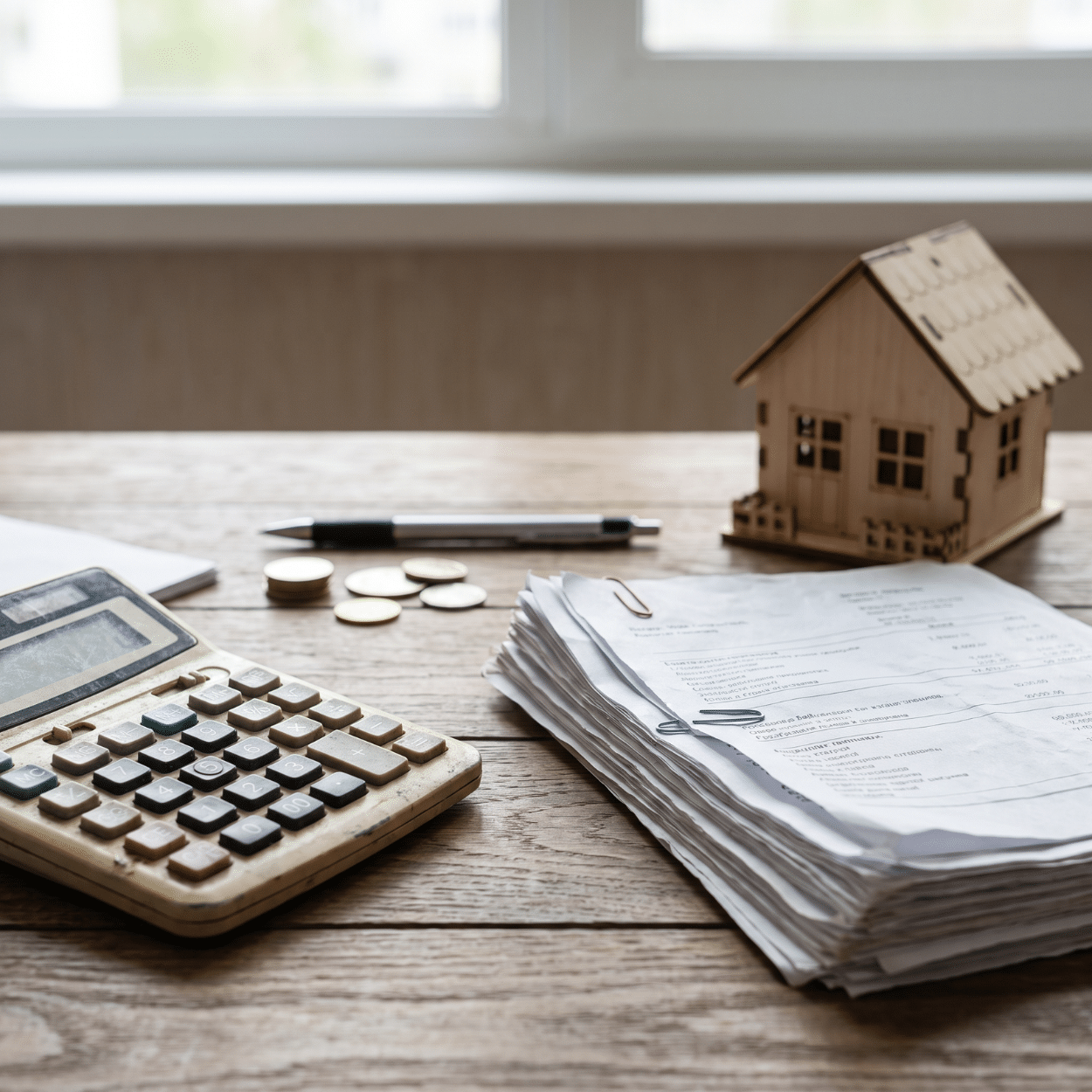
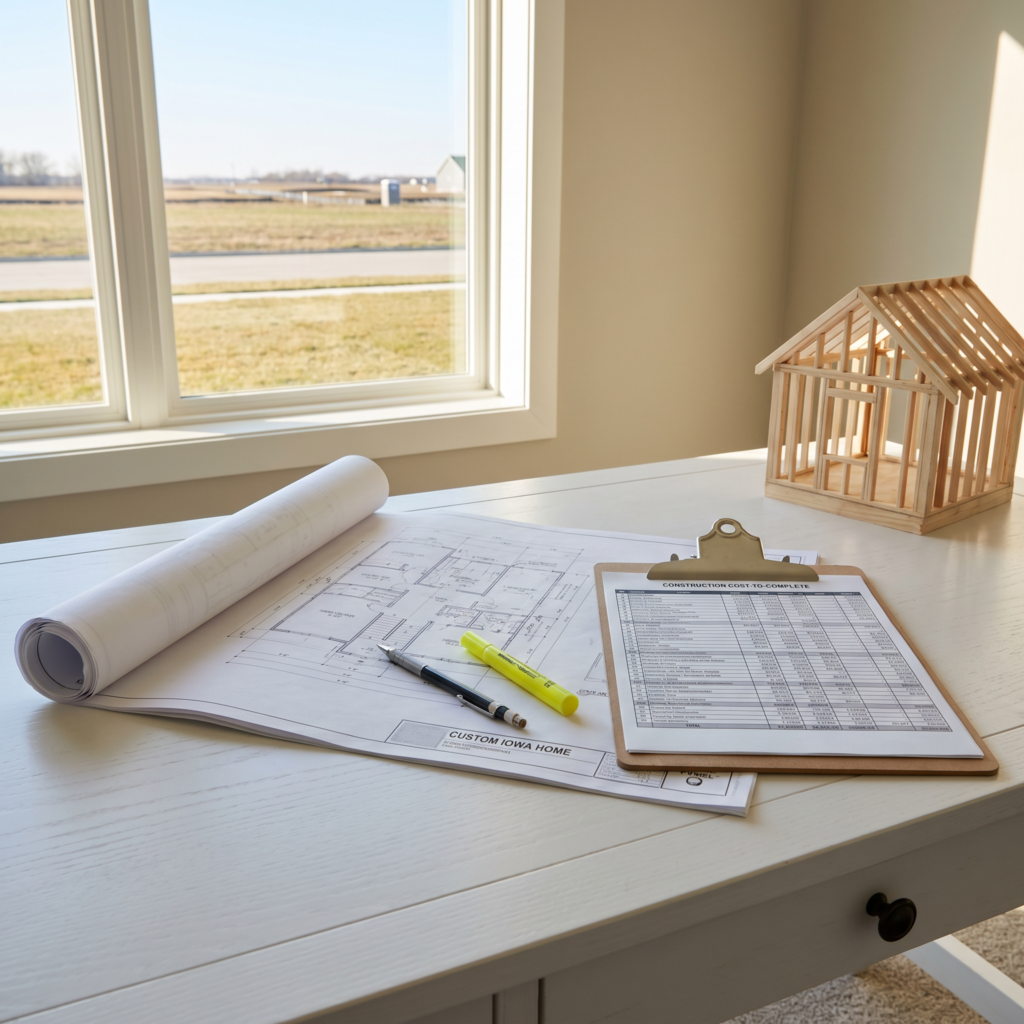
Financing a home you are building works nothing like getting a mortgage on a house that already exists. A construction loan releases money in stages, charges interest only on what you have drawn, and asks for paperwork a regular mortgage never touches. This guide explains how Iowa construction loans actually work, what lenders here require, and how to position yourself to qualify.
TLDR: Iowa construction loans work differently from regular mortgages. You draw funds in stages as the build progresses and pay interest-only until the home is complete. Most Iowa lenders require 10 to 20 percent down, a DIAL-registered contractor, and a detailed cost-to-complete breakdown before approving. Here is how the two main loan types work and what Iowa lenders actually require.
You have found your lot or your plan, and now you need to pay for the build. Then you learn that the home does not exist yet, so there is nothing for a normal mortgage to attach to. The bank cannot lend against a house that is still a set of drawings.
That is where a construction loan comes in. Instead of one lump sum at closing, it funds your build in pieces as the work gets done, then either converts to a permanent mortgage or gets refinanced when the home is finished. It is a different product with its own rules, and understanding it before you apply saves time and stress.
Below, we walk through the two main loan structures, what Iowa lenders require to approve you, the Iowa-specific factors that shape your loan, what it costs, the kinds of lenders you can choose from, and the step-by-step path from application to keys. By the end, you will know what to expect and how to prepare.
How Construction Loans Work in Iowa: One-Close vs. Two-Close
The first decision is the loan structure. There are two common approaches, and they differ in how many times you go to closing.
A one-close loan, sometimes called construction-to-permanent, combines the construction loan and the permanent mortgage into a single closing. You close once, the loan funds the build in draws, and then it converts to a regular mortgage when the home is complete. You lock terms up front and avoid a second round of closing costs.
A two-close loan separates the two. You take a short-term construction loan to fund the build, then apply for a separate permanent mortgage to pay off the construction loan at completion. You go to closing twice and pay closing costs twice, but you can shop the permanent mortgage separately when the home is done.
Most Iowa lenders favor the one-close structure for custom residential builds because it is simpler for the borrower and locks the permanent terms early. The table below compares them.
Table 1: One-close vs. two-close construction loans
| Factor | One-close | Two-close |
|---|---|---|
| Number of closings | One | Two |
| Closing costs | Paid once | Paid twice |
| Permanent rate locked | Early, at first closing | Later, at second closing |
| Flexibility to shop permanent loan | Lower | Higher |
| Common Iowa use | Custom residential builds | Borrowers wanting to re-shop later |
The takeaway: a one-close loan is simpler and usually cheaper in total fees, while a two-close gives you a second chance to shop the permanent mortgage. Both fund the build the same way, through draws.
A draw schedule is how the lender releases money in stages tied to construction milestones. The lender pays out as the foundation, framing, and finish phases complete, often after an inspection confirms the work. You pay interest only on the money drawn so far, not the full loan, until the home is done. Our guide to financing a custom home build in Iowa covers the financing picture more broadly, and our overview of construction loan requirements in Iowa sits alongside this one.
Pro Tip 1: Ask each lender whether they offer a one-close construction-to-permanent loan. For most custom builds in Iowa, closing once saves a full set of closing costs compared with a two-close structure.
Pro Tip 2: Get the draw schedule in writing before you close, and make sure your builder agrees to it. A mismatch between how the lender releases money and how your builder expects to be paid can stall a project mid-build.
What Iowa Lenders Require to Qualify
Construction loans carry more risk for the lender than a standard mortgage, so the approval bar is higher. Knowing the checklist lets you prepare before you apply.
Most Iowa lenders look for a solid credit score, often around 680 or higher, though the exact threshold varies by lender. They typically want 10 to 20 percent down, a manageable debt-to-income ratio, and proof that you either own the land or have it under contract. These are general lender norms, not lending advice, so confirm specifics with your lender.
Two requirements are specific to construction. First, lenders almost always require a registered contractor, and many ask for the contractor’s Iowa DIAL registration number as part of the file. Second, they want a detailed cost-to-complete breakdown and approved plans, so they can confirm the loan covers the full build. The table below lays out the common requirements.
Table 2: Typical Iowa construction loan requirements
| Requirement | Typical expectation | Why the lender wants it |
|---|---|---|
| Credit score | Often 680 or higher | Measures repayment risk |
| Down payment | 10 to 20 percent | Borrower equity in the build |
| Debt-to-income ratio | Within lender limits | Confirms you can carry payments |
| Land status | Owned or under contract | Secures the loan to a site |
| Registered contractor | DIAL registration number | Confirms a qualified builder |
| Cost-to-complete and plans | Detailed and approved | Confirms the loan funds the full build |
The takeaway: the contractor and the cost breakdown are what set a construction loan apart from a mortgage, so line those up early. Lenders use the term “registered contractor” because Iowa registers, rather than licenses, general contractors. You can verify a contractor’s registration on the state’s records site.
Pro Tip 3: Have your contractor’s DIAL registration number ready before you apply. Many Iowa lenders require it in the loan file, and providing it up front keeps your application moving.
Pro Tip 4: Build your cost-to-complete breakdown with your contractor, line by line, before you meet the lender. A detailed, realistic budget is one of the strongest things you can bring to an approval conversation.
Iowa-Specific Factors That Affect Your Loan
Iowa adds a few wrinkles to construction lending that borrowers from other states do not expect. Each one can affect your approval or your interest-only window.
First, the contractor requirement has teeth here. Iowa lenders want a DIAL-registered contractor, and using an unregistered builder can void your approval. Registration is not a formality to the lender. It is part of how they confirm the build will be done by someone the state recognizes.
Second, Iowa permit timelines stretch the construction period. In some Polk County suburbs, permit review can take six to twelve weeks, and that delay extends your build and your interest-only payment window. A longer build means more months of interest-only payments before you move in. Our guide to how long it takes to build a custom home explains where the time goes.
Third, Iowa lot values vary widely, which affects how much equity your land brings. A rural lot that needs a well and septic system is a different financial picture from an in-development lot with utilities at the curb. Lenders weigh the finished value and the land value differently depending on the site.
Pro Tip 5: Confirm your contractor’s DIAL registration is active before you apply, not after. Discovering a lapsed registration during underwriting can derail an approval that was otherwise on track.
Pro Tip 6: Factor the permit window into your interest-only budget. If your suburb takes ten weeks to approve a permit, that is roughly ten extra weeks of interest-only payments to plan for.
Construction Loan Interest Rates and Costs in Iowa
Construction loans cost more to carry than a finished-home mortgage, and the fee structure is different. Knowing the pieces helps you budget the true cost.
Construction loan rates typically run somewhat higher than traditional mortgage rates, and the rate during construction is often variable rather than fixed. On top of the rate, expect origination fees, inspection or draw fees each time the lender releases money, title insurance, and a reserve requirement in some cases. These vary by lender, and this is not lending advice, so get a full fee sheet from yours.
The biggest cost most borrowers underestimate is time. Because you pay interest only during construction, a build that takes twelve to eighteen months means a year or more of interest-only payments before you ever move in. A longer build is not just a scheduling issue. It is a real carrying cost, and our guide to what it costs to build a custom home shows how the total loan amount adds up. National construction cost data from the U.S. Census Bureau and its new residential construction figures show how build costs have climbed, which raises the loan amount you are carrying interest on. Building to a higher energy standard, using the Department of Energy’s weatherization guidance, can lower the operating costs you carry once the loan converts to a mortgage.
The federal Consumer Financial Protection Bureau publishes plain-language guidance on the home-financing process that is worth reading before you apply, so you walk in knowing the vocabulary.
Pro Tip 7: Ask the lender to list every fee in writing: origination, each draw or inspection fee, title, and any reserve. Draw fees add up over a long build, and they are easy to overlook when comparing offers.
Pro Tip 8: Budget for the full interest-only period, not just the construction cost. If your build runs fifteen months, plan for fifteen months of interest-only payments on top of your current housing cost.
Iowa Lender Types: Local Banks, Credit Unions, and National Lenders
Where you borrow matters as much as how. The three main lender types in Iowa handle construction loans differently.
Community banks and Iowa credit unions often offer more flexible draw schedules and a closer working relationship, since they know local builders and the local market. National lenders tend to have standardized programs that can be efficient but offer less room to adjust the draw schedule to your project. Each has a place depending on what you value.
The table below compares the lender types.
Table 3: Iowa construction lender types
| Lender type | Strengths | Trade-offs |
|---|---|---|
| Community banks | Local knowledge, flexible draws | Programs vary by bank |
| Iowa credit unions | Member focus, competitive terms | Membership may be required |
| National lenders | Standardized, broad programs | Less draw-schedule flexibility |
The takeaway: local banks and credit unions often flex the draw schedule to fit your build, while national lenders trade flexibility for standardized efficiency. Talk to more than one before you choose. Our look at Iowa home builder financing strategies covers how to approach the conversation, and our piece on whether you can build a custom home under $500k shows how budget shapes lender choice.
Pro Tip 9: Get quotes from at least one community bank or credit union and one larger lender. The draw-schedule flexibility a local lender offers can matter more to your build than a small difference in fees.
Pro Tip 10: If you belong to an Iowa credit union, start there. Member-owned lenders sometimes offer construction terms worth comparing, though you should still shop at least one other option.
Step by Step: From Application to Keys
The path from loan application to move-in follows a predictable sequence. Knowing the order helps you plan and spot delays early.
It runs roughly like this: pre-qualification, finalize your plans and cost-to-complete, submit the full loan application, the lender orders an appraisal of the finished-home value, underwriting reviews everything, you close, the draw schedule begins, construction proceeds with inspections at each draw, a final inspection and certificate of occupancy confirm the home is done, and the loan converts to a permanent mortgage or is refinanced.
The table below shows the typical timeline.
Table 4: From application to certificate of occupancy
| Step | What happens | Typical window |
|---|---|---|
| Pre-qualification | Initial review of your finances | A few days |
| Plans and cost-to-complete | Finalize budget and drawings | Varies by design |
| Application and appraisal | Full file, finished-value appraisal | 2 to 4 weeks |
| Underwriting and closing | Lender approves, you close | 2 to 4 weeks |
| Construction and draws | Build proceeds, draws released | Months, varies by build |
| Final inspection and CO | City confirms completion | 1 to 3 weeks |
| Loan conversion | Converts or refinances to mortgage | At completion |
The takeaway: the financing and the build run on parallel tracks, and a registered contractor who hits the draw milestones keeps both on schedule. Our look at a ranch versus a two-story custom home shows how the plan you finance shapes the build.
These illustrative scenarios show how the path plays out for different borrowers. They are examples, not specific Busy Builders projects or lending offers, and your terms will vary.
Illustrative scenario, one-close in Johnston: A couple with strong credit and 20 percent down chooses a one-close loan for a custom build. They lock permanent terms at the first closing, draw funds through the build, and the loan converts to a mortgage at completion, with no second set of closing costs.
Illustrative scenario, rural Story County two-close: A family building on a rural lot with a well and septic uses a two-close structure so they can re-shop the permanent mortgage when the home is finished. The land they already own counts toward their equity in the construction loan.
Illustrative scenario, owned lot in Waukee: A homeowner who already owns a lot in Waukee applies for a construction loan, and the lender treats the owned land as equity toward the down payment, reducing the cash they need at closing.
Pro Tip 11: Start the loan conversation before your plans are fully final. A lender can pre-qualify you early, which tells you your realistic budget before you over-design a home you cannot finance.
Pro Tip 12: Choose a registered contractor with a track record of hitting draw milestones. Lenders release money on inspections, so a builder who keeps the schedule keeps your financing healthy. For the full picture of how a build comes together, our home building service page explains our approach across Central Iowa, and our Ankeny home building page covers that market.
Frequently Asked Questions
Q: What is a construction loan and how does it work in Iowa? A construction loan is short-term financing that funds a home build in stages called draws, rather than as one lump sum. You pay interest only on the money drawn so far until the home is complete, then the loan either converts to a permanent mortgage or is refinanced. Iowa lenders release draws as construction milestones pass, often after an inspection. Talk to a lender early so you understand the draw schedule before you break ground.
Q: How much down payment do you need for a construction loan in Iowa? Most Iowa lenders require 10 to 20 percent down for a construction loan, though the exact figure depends on the lender, your credit, and the project. If you already own your land, many lenders count that equity toward your down payment, which can reduce the cash you need at closing. These are general norms, not lending advice. Ask your lender how they treat owned land and what down payment your situation requires.
Q: Do Iowa lenders require a licensed or registered contractor for a construction loan? Many homeowners assume they need a registered general contractor, but Iowa registers general contractors rather than licensing them. Lenders therefore require a registered contractor, and many ask for the DIAL registration number in the loan file. Using an unregistered contractor can void your loan approval. Electrical, plumbing, and heating work is performed by licensed subcontractors your builder coordinates. Verify your contractor’s registration on the state’s records site before you apply, and confirm it is active.
Q: How long does a construction loan last in Iowa? A construction loan typically covers the build period, often twelve to eighteen months for a custom home, during which you make interest-only payments. Once the home is complete and passes final inspection, the loan converts to a permanent mortgage or is paid off by a separate one. Iowa permit timelines and weather can extend the build, which extends the interest-only window. Build a realistic schedule with your contractor so you can budget the carrying cost.
Q: Can you get a construction loan to build on land you already own in Iowa? Yes, and owning your land can work in your favor. Most Iowa lenders treat owned land as equity toward your down payment, which can lower the cash you bring to closing. You will still need approved plans, a detailed cost-to-complete, and a registered contractor. Talk to your lender about how they value your specific lot, since a rural parcel and an in-development lot are weighed differently.
Key Takeaways
Two main loan structures
- One-close combines construction and permanent loans into a single closing.
- Two-close separates them, with a second closing and second costs.
- Iowa lenders often favor one-close for custom residential builds.
Lenders require more than a mortgage does
- Often a 680-plus credit score and 10 to 20 percent down.
- A DIAL-registered contractor and registration number.
- A detailed cost-to-complete breakdown and approved plans.
Iowa factors shape the loan
- Unregistered contractors can void approval.
- Permit timelines extend the interest-only window.
- Lot type and value affect your equity and approval.
Plan for the true cost
- Rates run higher than mortgages and are often variable during the build.
- Origination, draw, title, and reserve fees add up.
- Budget for a full year or more of interest-only payments.
Choose your lender deliberately
- Local banks and credit unions often offer flexible draws.
- National lenders trade flexibility for standardized programs.
- Shop more than one before you commit.
Ready to Plan the Build Behind the Loan?
You now understand how Iowa construction loans work, what lenders here require, and how to prepare to qualify. Financing is only half the picture. The other half is a builder who keeps the construction, and your draw schedule, on track.
Busy Builders has completed 1,285+ projects across Central Iowa since 2020. We bring transparency, local code knowledge, and straight answers to every project. Here is what working with us looks like:
- Free consultation to talk through your build and budget
- Clear, itemized cost-to-complete breakdowns lenders can use
- A registered Iowa contractor with a DIAL registration number on file
- Coordination with licensed subcontractors for electrical, plumbing, and heating work
- Written warranty on workmanship (details provided in your contract)
Ready to move forward? Contact us today.
Call: 844-435-9800
Website: https://busybuildersiowa.com/
We serve West Des Moines and communities across Central Iowa.
Disclaimer: This article is for general information and is not project-specific or lending advice. Cost figures are planning estimates that vary by scope, materials, site conditions, and current pricing. Construction lending terms, rates, draw schedules, and fees vary by lender; consult your lender for terms specific to your situation. ROI and resale figures are illustrative and not financial advice; actual results vary by market and project quality. Permit requirements vary by city and jurisdiction; verify current requirements with your local building authority before starting any project. No specific outcomes are guaranteed. Consult a registered contractor, and the appropriate licensed subcontractors for electrical, plumbing, and heating work, for guidance specific to your project.
Busy Builders | Full-Service Construction and Remodeling | Serving Central Iowa Since 2020