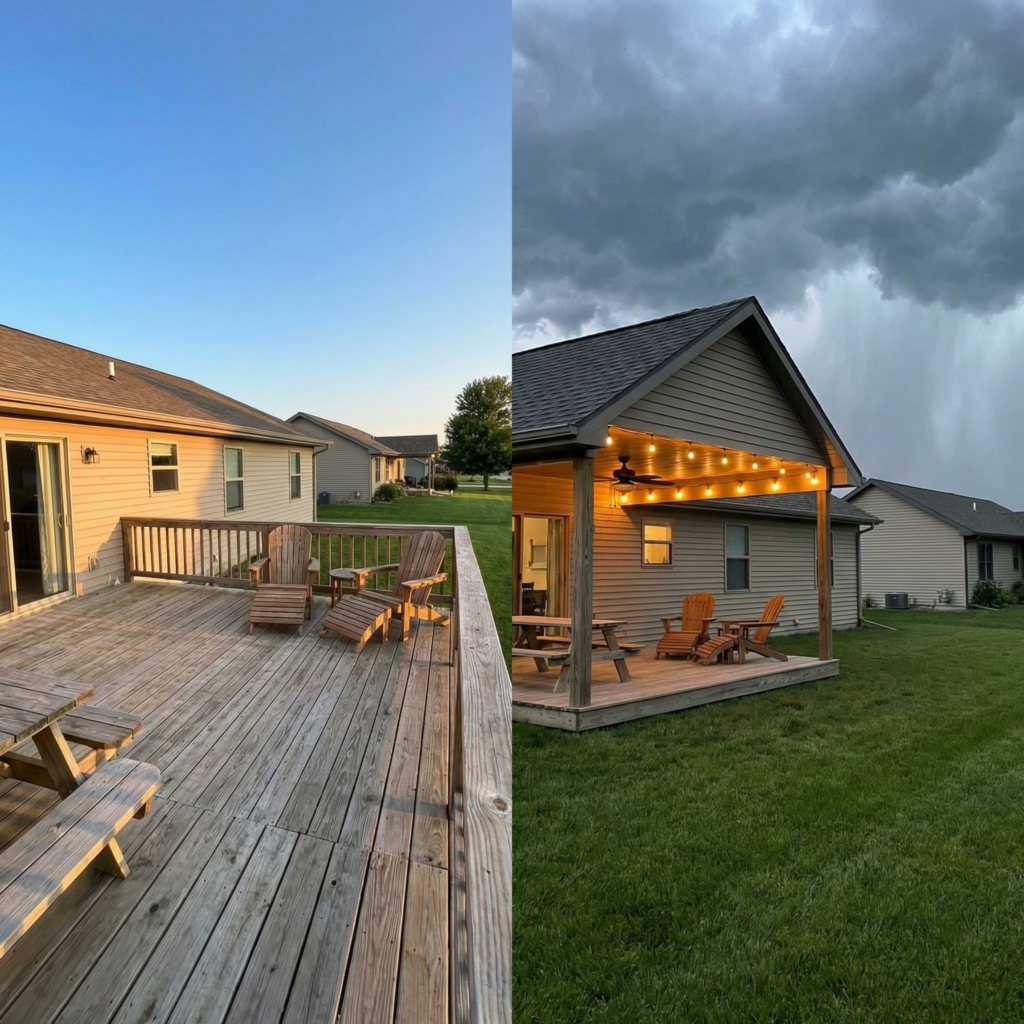
Most covered-versus-open-deck comparisons are written for a national audience. Iowa is not a national audience market. Des Moines averages 40 to 50 thunderstorm days per year, Iowa records about 48 tornadoes annually, and the state sits in the Midwest derecho corridor. That weather reality makes this a genuinely different decision here than it would be in a mild-weather state, and that is where this guide starts.
This article provides general planning information only. All cost figures are planning estimates that vary significantly by deck size, materials, design, site conditions, and contractor. Nothing in this article constitutes a financial guarantee or professional advice. Verify permit requirements with your local building department before starting any project.
TLDR: Open decks return 94.9% of cost at resale for wood and 88.5% for composite per the 2025 Zonda Cost vs. Value Report, among the best-documented returns of any home improvement project. A covered structure adds meaningful Iowa-specific usability but costs significantly more and lacks a national resale benchmark. The right choice depends on how long you plan to stay, how much you entertain, and which you’re optimizing for, daily lifestyle or resale return. This post gives you the honest math on both.
Why Iowa Weather Makes This Decision Harder Than It Looks
Iowa’s outdoor season is generous on paper, roughly May through October, but it comes with a catch. Des Moines averages 40 to 50 thunderstorm days per year, and Iowa’s position in the Midwest derecho corridor means severe weather can end an outdoor gathering in minutes. The 2020 derecho resulted in more than $1.6 billion in paid insurance claims in Iowa, according to the Iowa Insurance Division. It made it clear that outdoor structures here need to be built with Iowa’s climate in mind, not national averages.
An uncovered deck in Iowa can be genuinely unusable on many summer evenings. The question is not whether weather protection is valuable, it clearly is. The question is whether that value, priced at hundreds to tens of thousands of dollars, justifies the premium over the better-documented return of an open deck.
The honest framing: open decks deliver better resale ROI. Covered decks deliver better daily usability. Which matters more depends entirely on your situation.
There is also a structural reality to factor in early. West Des Moines requires outdoor structures to meet a 105-115 mph wind design speed and a 30 pounds per square foot snow load for covered roofs. Every Central Iowa deck footing, whether open or covered, must reach 42 inches below grade to satisfy the frost line requirement. These are not optional specifications. They affect both project cost and engineering scope, particularly for covered structures.
What Each Option Costs in Iowa 2026
Cost depends heavily on deck size, materials, and how much engineering the covered structure requires. The table below reflects 2026 Central Iowa planning estimates across the most common configurations.
| Option | Typical Iowa Range | Notes |
|---|---|---|
| Open pressure-treated wood deck (200 sqft) | $8,000 to $15,000 | Basic; ground-level |
| Open composite deck (200 sqft) | $10,000 to $18,000 | Mid-range composite; lower maintenance |
| Pergola over existing deck (open lattice) | $4,000 to $15,000 | Partial shade; no rain protection |
| Louvered pergola (adjustable) | $9,000 to $25,000 | Premium option; opens and closes |
| Lean-to roof over existing deck | $4,000 to $10,000 | Gable roof addition over a 200 sqft deck |
| Gable roof addition over 200 sqft deck | $14,000 to $31,000 | Fully weather-protected; engineering required |
| Screen enclosure over existing deck | $2,000 to $5,800 | Bug and weather protection |
Planning estimates for the 2026 Central Iowa market conditions. Actual costs vary by size, materials, site conditions, and contractor. Get at least three quotes before committing.
One 2026-specific cost factor worth knowing: framing lumber is up approximately 16% year-over-year as of spring 2026, with combined Canadian anti-dumping and countervailing duties creating a structural cost floor that keeps domestic prices elevated. If you are planning a covered structure this year, getting quotes and locking in materials early gives better price certainty than waiting. This applies to open decks too, but the lumber premium is more significant for covered structures because roofing framing adds substantially more wood volume.
Iowa’s frost line adds a cost that surprises many homeowners. All deck footings, including posts for covered structures, must reach 42 inches below grade in Central Iowa. That excavation and concrete cost is real and non-negotiable regardless of project type.
For a detailed look at Iowa deck-building costs, permits, and code requirements, including site-specific variables that affect pricing, the Busy Builders deck guide covers the full scope.
ROI and Resale, What the Data Actually Says
This is where the open deck clearly wins, with documented evidence.
According to the 2025 Zonda Cost vs. Value Report, a wood deck addition returns 94.9% of its cost at resale nationally, ranking it among the best-performing exterior improvements tracked. A composite deck returns 88.5%. Both figures are based on a standard 16-by-20-foot deck with a built-in bench, stairs, and complete railing.
| Project | Average Cost | Resale Value Added | ROI |
|---|---|---|---|
| Wood deck addition | $18,263 | $17,323 | 94.9% |
| Composite deck addition | $25,096 | $22,199 | 88.5% |
| Screened porch or covered patio | Varies | Not benchmarked | ~70 to 80% (industry estimate) |
ROI figures from the 2025 Zonda Cost vs. Value Report (not the NAR Remodeling Impact Report, which uses a different methodology and produces different figures), national averages. Screened porch and covered patio figures are industry estimates without equivalent national benchmarking. Actual returns vary by property, location, market conditions, and quality of work. These figures do not constitute financial advice.
Covered decks and patios do not have a nationally benchmarked ROI figure. Industry estimates put screened porches and covered patios at roughly 70 to 80%, but those figures are not sourced from a rigorous national survey, unlike Zonda’s data. The honest disclosure: covered structures add usable square footage and are appealing to buyers, but the resale recoupment is not documented to the same standard as open decks. Claiming a specific dollar amount for a covered deck would be an overclaim.
What matters most in any Iowa suburban market, Ankeny, Waukee, Johnston, Grimes, is condition and neighborhood. A well-built, well-maintained deck of either type in a home with good overall condition will attract buyers. Iowa’s weather makes a covered outdoor space genuinely valuable to buyers who understand the climate. Still, that value is harder to measure at the appraisal stage than an open deck is.
Permits and Code, What Iowa Requires
Every covered structure and most open decks require permits. This is not a technicality, unpermitted deck work creates liability at resale and, for covered structures specifically, can create real structural safety issues if the engineering requirements for Iowa’s wind and snow loads are not met.
| Structure Type | Permit Required? | Notes |
|---|---|---|
| A building permit required in all Iowa municipalities | Yes | Pergola attached to the house |
| Open freestanding deck over 30 inches | Yes | Most municipalities require it; verify locally |
| Any covered deck with an attached roof | Yes | Structural connection triggers permit |
| Detached pergola under 100 to 120 sqft | Often no | Varies by municipality, always verify |
| Structural and building permits are required | Yes | Structural changes trigger a permit |
| Screen enclosure over existing deck | Yes | Structural changes trigger permit |
Always verify permit requirements with your specific city’s building department before starting work or ordering materials.
Iowa general contractors must be registered, not licensed, with the Iowa Department of Inspections, Appeals, and Licensing (DIAL). Verify any contractor at dial.iowa.gov before signing a contract. Structural engineers and electricians hold separate licenses, for covered structures that require electrical work or engineered roof framing, confirm all subcontractors are properly credentialed.
Which Option Is Right for You?
This decision splits cleanly along two variables: how long you plan to stay, and what you are optimizing for.
| Your Situation | Better Choice | Reason |
|---|---|---|
| Primary goal: resale value | Open deck | 94.9% wood ROI; nationally benchmarked |
| Primary goal: daily outdoor living | Covered deck or pergola | Covered additions start at $4,000+ over the base deck |
| Budget under $15,000 | Open wood deck | Full weather protection is achievable at this range |
| Budget $20,000 to $35,000+ | Covered deck or louvered pergola | Full weather protection achievable at this range |
| Entertaining priority | Covered or screened | Iowa storm season limits uncovered hosting |
| Selling in 1 to 2 years | Open composite deck | Better-documented ROI; lower upfront cost |
| Long-term ownership (10+ years) | Covered deck | Lifestyle value compounds over time |
| HOA community | Verify HOA documents first | HOA may restrict roof structures or materials |
One practical option many Iowa homeowners overlook is the phased approach: build the open deck now, add the roof later. It costs roughly the same in total as building covered from the start, but it gives you two years of data about how you actually use the space before committing the additional $5,000 to $15,000 for a cover.
For context on how outdoor living investments compare with other Central Iowa home improvements, the Busy Builders home building and remodeling service overview covers the full range of project types and the factors that drive value in different scenarios.
Two Iowa Scenarios
Illustrative scenario 1: A couple in Johnston builds a 16-by-20-foot open composite deck for $14,000 to $18,000. They plan to sell in three years. At an 88.5% ROI (Zonda 2025 composite figure), they expect to recoup $12,400 to $15,900 at resale, a net cost of roughly $2,100 to $2,600 for four years of outdoor living, plus improved curb appeal. This is an illustrative scenario, not a quote or guarantee.
Illustrative scenario 2: A family in Ankeny builds a 16-by-20-foot pressure-treated open deck for $12,000, then adds a lean-to roof over half the deck two years later for approximately $5,500, for a total investment of about $17,500. The phased approach lets them verify how they use the space before committing to covered infrastructure. The total cost is similar to building covered from the start, but they had two years of real usage data before spending the additional money. This is an illustrative scenario, not a quote or guarantee.
FAQs
Q: Does a covered deck add more value than an open deck in Iowa? Open decks have better-documented resale ROI, 94.9% for wood and 88.5% for composite per the 2025 Zonda Cost vs. Value Report. Covered structures are estimated at roughly 70 to 80% ROI by industry sources, but no equivalent national benchmark exists for covered decks as a standalone category. Iowa’s storm-heavy climate makes covered outdoor space genuinely appealing to buyers who understand the weather. Still, that buyer appeal is harder to translate to a specific appraisal number than an open deck. Condition and neighborhood matter more than covered versus open in most Iowa resale scenarios.
Q: How much more does a covered deck cost than an open deck in Iowa? A basic lean-to roof over an existing deck adds $4,000 to $10,000. A full gable roof over a 200-square-foot surface adds $14,000 to $31,000, depending on engineering complexity. All deck posts and columns, covered or open, require footings at 42 inches below grade in Central Iowa, which adds excavation and concrete cost to any project. Lumber prices are up approximately 16% year-over-year as of spring 2026 due to Canadian anti-dumping and countervailing duties, so getting quotes early in the 2026 season gives better price certainty.
Q: Do I need a permit for a covered deck or pergola in Iowa? Yes, any covered structure attached to the home requires a building permit, with no exceptions. Pergolas over 100 to 120 square feet typically require permits,s even if they are freestanding, though this threshold varies by municipality. A detached pergola under that size may be exempt, but always verify with your specific city before ordering materials. Covered decks must also meet Iowa’s wind and snow load requirements, in West Des Moines, that means 105 to 115 mph wind design speed and 30 psf snow load for any roof structure.
Q: Can Iowa’s weather justify the cost of a covered deck? For long-term owners who entertain regularly, yes. Des Moines averages 40 to 50 thunderstorm days annually, and Iowa’s position in the derecho corridor means severe weather can end outdoor gatherings without warning. An uncovered deck can be genuinely unusable on many summer evenings in Central Iowa. For homeowners planning to sell in the next two to three years, an open deck delivers better-documented return on investment and lower upfront cost. The weather argument for covered structures is strongest when paired with long-term ownership.
Q: Is 2026 a good time to build a deck in Iowa? Yes, with one practical caveat. Iowa construction costs run about 14% below the national average, making this one of the more builder-friendly states in the country. However, framing lumber is up approximately 16% year-over-year as of spring 2026 due to combined Canadian anti-dumping and countervailing duties, and prices are projected to continue trending upward. Getting quotes early in the season and locking in materials before fall pricing cycles gives better certainty than waiting. The underlying labor and material advantages Iowa offers remain intact, 2026 remains a solid year to build.
Key Takeaways
The ROI case favors open decks clearly, wood at 94.9% and composite at 88.5% per the 2025 Zonda Cost vs. Value Report. No national benchmark exists for covered decks, though industry estimates suggest 70-80%.
Iowa’s weather makes covered structures genuinely more functional here than in milder markets. The 40 to 50 annual thunderstorm days and derecho exposure are real factors for anyone who entertains regularly outdoors.
Every deck footing in Central Iowa must reach 42 inches below grade, this is non-negotiable and affects every project’s concrete and excavation cost. Covered structures with engineered roofs must meet West Des Moines’ 105-115 mph wind design speed and 30 psf snow load requirements.
Permits are required for virtually all deck and covered structure work. Verify with your specific city’s building department before starting. Check contractor registration at dial.iowa.gov before signing anything.
The phased approach, open deck now, roof later, is a practical middle path that Iowa homeowners underuse.
Ready to Talk Through Your Deck Project?
Busy Builders has completed more than 1,285 projects across Central Iowa since 2020, including open decks, covered structures, pergolas, and phased builds. The right choice for your yard, your budget, and your timeline is worth talking through before committing to either option.
Call us: 844-435-9800 Website: busybuildersiowa.com
Busy Builders serves Des Moines, West Des Moines, Ankeny, Grimes, Waukee, Johnston, Urbandale, and communities across all ten Central Iowa service counties.
Busy Builders | Full-Service Construction and Remodeling | Serving Central Iowa Since 2020
Related service: deck building in Central Iowa.