
Kitchen Remodel Timeline in Iowa: How Long Does It Take in 2026?
Wondering how long your kitchen will be out of commission? A kitchen remodel in Iowa runs longer than most expect, and the reason is usually sitting in a cabinet...
Clive kitchens have a pattern. Closed-off layouts from the 1970s and 1980s, electrical panels that top out at 100 amps, and exhaust fans dumping air into the attic instead of outside. These are not cosmetic problems. They affect how your kitchen works every single day.
Busy Builders remodels kitchens throughout Clive, from targeted cosmetic upgrades to full gut remodels that open walls, rewire electrical service, and replace everything down to the subfloor. We pull permits through Clive Development Services, coordinate licensed electricians and plumbers, and manage structural changes with engineered drawings when walls come down.

Since 2020, Busy Builders has completed 1,285+ construction and remodeling projects across Central Iowa, including kitchen remodels throughout the west-side suburbs. Clive homeowners are long-term owners. They are not flipping homes. They want quality that lasts, and they notice the difference between a contractor who plans ahead and one who surprises them mid-project.
Clive kitchens built before 1990 frequently have 60-to-100-amp panels that cannot support a modern kitchen’s electrical load. A panel upgrade runs $3,000 to $8,000 and is one of the most common hidden costs we flag during walkthroughs, not after demo begins.
We give Clive homeowners a clear written scope before any demo begins. That includes an honest assessment of what we are likely to find in pre-1990 homes, a recommended 15-to-20% contingency budget for hidden conditions, and pricing consistent with what we deliver across the Des Moines metro.
We want to be the registered contractor that Clive homeowners trust with their most-used room. From kitchen remodeling across Central Iowa to structural wall removal in established west-side homes, we bring transparency to every estimate, every permit, and every walkthrough.
Before any demo begins, we walk through your Clive kitchen and assess what stays and what goes.
We check your electrical panel capacity, plumbing supply lines, exhaust fan routing, subfloor condition, and whether any walls are load-bearing. In pre-1990 Clive homes, we routinely find 60-100 amp panels that need upgrading before a modern kitchen can function safely. We find galvanized supply lines that have corroded past their useful life. We find exhaust fans venting into the attic instead of the exterior, which is a code violation under Iowa’s adopted NEC 2023. None of this surprises us. We flag every issue at the walkthrough so your budget reflects reality before a single cabinet is ordered.
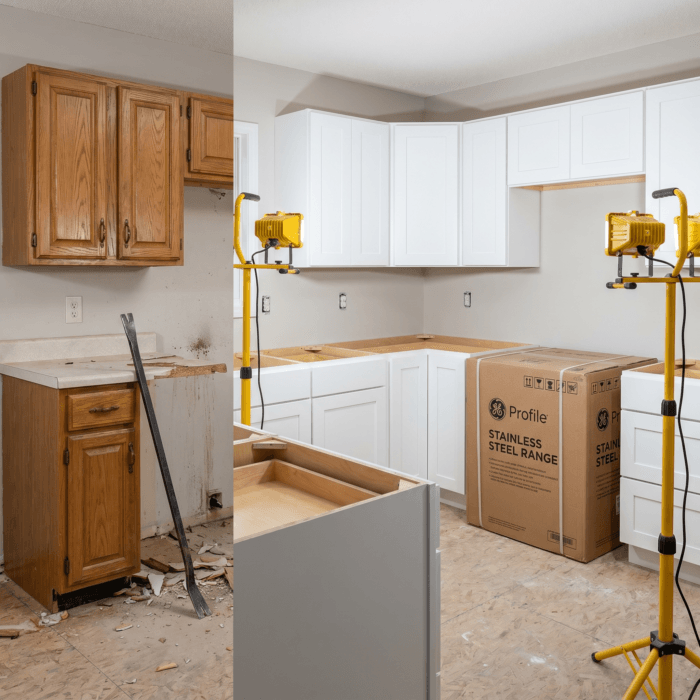
Demo is where Clive kitchens reveal what decades of Iowa humidity have been hiding. Pre-1990 homes throughout Clive regularly turn up water-damaged subfloor under appliances, corroded galvanized supply lines, asbestos floor tile beneath existing flooring, and rot around the sink base cabinet. Homes built before 1980 are the most likely to carry these surprises. Our team flags hazardous materials before demo begins and coordinates abatement when needed. Addressing these issues early protects your timeline and keeps your budget from being blindsided mid-project.
Open-concept conversions are the most-requested structural change in Clive kitchen remodels. Closed layouts from 1970s and 1980s construction wall off kitchens from living and dining areas in ways that no longer fit how families cook and gather today. Removing those walls requires a structural assessment before any demo touches the framing.
Load-bearing walls, which are walls that hold up the house above them, require engineered headers and permit drawings before removal. Our team identifies load-bearing conditions at the walkthrough, not after demo starts. That early assessment protects your budget and your timeline. For a deeper look at what structural changes cost in Central Iowa, visit our kitchen remodeling services page.
Moving the sink, adding a prep sink, relocating the dishwasher drain, or running a refrigerator water line all happen while walls and floors are open in your Clive kitchen. This is the lowest-cost window to change plumbing locations. Once walls close, the same changes cost significantly more and add days to the schedule.
Many pre-1980 Clive homes still have corroded galvanized supply lines that need full replacement before new fixtures go in. Swapping to PEX supply lines during rough-in is far more affordable than addressing them after the kitchen is finished. Our licensed plumbers handle every relocation and inspection as part of your kitchen remodeling project in Clive.
Electrical rough-in covers new circuits, outlet placement, under-cabinet lighting wiring, pendant fixture rough-in, exhaust fan wiring, and dedicated appliance circuits for the refrigerator, dishwasher, range, and microwave.
Under Iowa NEC 2023 with state amendments, GFCI protection is required on all countertop outlets and AFCI protection is required on all new kitchen branch circuits. Every appliance circuit must be dedicated. In pre-1990 Clive homes, 60 to 100 amp panels are common and typically cannot support a modern kitchen. Panel upgrades run $3,000 to $8,000 and are one of the most frequent budget surprises in kitchen remodels on Clive’s west side. Our licensed electricians identify panel capacity issues at the walkthrough so there are no surprises mid-project.
Range hood ventilation is one of the most commonly mishandled details in Clive kitchen remodels.
Iowa adopted NEC 2023, which requires all exhaust fans and range hoods to vent to the exterior, not recirculate air inside the kitchen or dump moisture into the attic. Many Clive homes built before 1990 have exhaust fans that vent directly into attic cavities. That is a code violation and a real moisture problem. Attic venting traps grease, steam, and humidity where it accelerates wood rot and mold growth. During your walkthrough, we identify existing exhaust routing and flag any attic-venting setups before your project starts. Rerouting to an exterior wall or roof penetration requires a building permit in Clive. We handle that permit coordination as part of your project scope.
Drywall goes up after all mechanical inspections are passed in your Clive kitchen.
We hang, tape, mud, and sand every surface to a smooth, paint-ready finish. Moisture-resistant drywall goes on all kitchen walls, especially behind the backsplash area and above the sink where humidity and splashing are constant. Clive kitchens experience real humidity swings between Iowa’s dry winters and humid summers, and standard drywall breaks down faster in those conditions. Moisture-resistant board holds up better and keeps your finished walls looking clean for years. If your project involved removing a load-bearing wall to open your kitchen layout, ceiling patching and texture matching are included in this phase.
Cabinets go in after drywall is complete and walls are primed in your Clive kitchen.
Upper cabinets are hung first, then base cabinets are set and leveled across the floor. Every cabinet is secured to studs with proper fasteners. Iowa’s seasonal humidity causes wood to move, and we account for that during installation by specifying plywood box construction over particle board whenever possible. Plywood holds fasteners longer and resists moisture better in Clive’s climate, where kitchen humidity can swing from 35% in winter to 65% in summer. Semi-custom cabinetry is the most common choice in Clive because it balances finish quality with lead times that fit realistic project schedules.
Countertops are templated after cabinets are fully installed and leveled. In Clive kitchens, quartz is the dominant countertop choice, and for good reason. Iowa’s humidity swings from roughly 35% in winter to 65% in summer, and quartz handles that stress without sealing or special maintenance. Granite and engineered stone can work, but quartz holds up better through Central Iowa’s seasonal extremes.
Slabs are fabricated to the template, then installed with proper support and adhesive. Undermount sinks are set into the cutout during this stage, before the backsplash goes in. That sequence matters because the tile or stone backsplash needs to meet the countertop cleanly. Our team coordinates the fabricator’s schedule so there are no gaps in the project timeline.
Appliances are delivered and installed after countertops and backsplash are complete. This sequencing protects finished surfaces from damage during delivery, which matters in a high-finish Clive kitchen remodel where countertop and tile work represents a significant share of the budget.
Refrigerator, range, dishwasher, and disposal are connected, tested, and confirmed operational before the project moves to final walkthrough. Fixtures and cabinet hardware are installed at this stage as well. In pre-1990 Clive homes, dedicated 20-amp circuits for the refrigerator, dishwasher, and disposal are required under Iowa’s adopted NEC 2023.
Flooring and final paint wrap up your Clive kitchen before the walkthrough begins.
We apply paint after cabinets and tile are set so every edge cuts in cleanly against finished surfaces. We use moisture-resistant kitchen paint because standard interior paint breaks down fast in Clive homes, where cooking heat and Iowa’s humidity swings from dry winter air to humid summer conditions put walls through a real workout season after season.
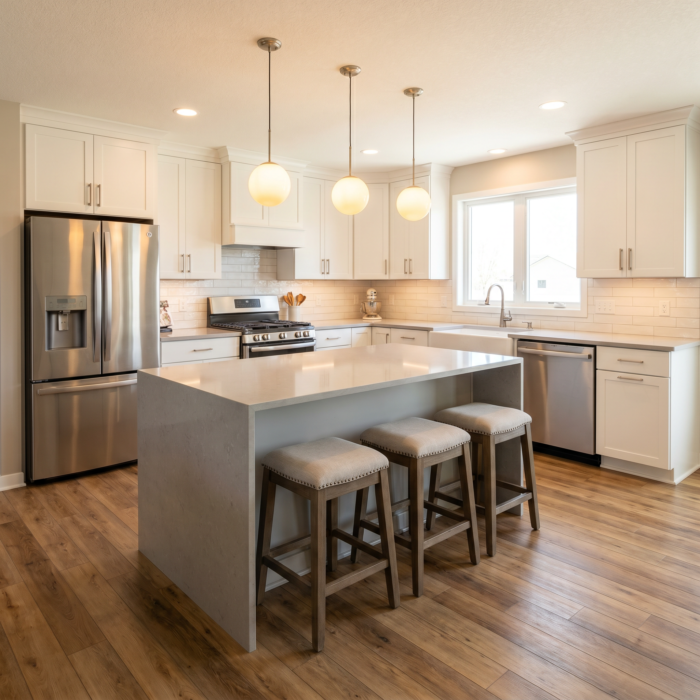
For flooring, most Clive homeowners choose luxury vinyl plank (LVP) over solid hardwood. LVP handles moisture around the sink and dishwasher without warping or gapping, which matters in a Central Iowa kitchen where relative humidity can shift 30 points between January and July.
The final walkthrough is where we go through every detail of your Clive kitchen together before calling the project complete.
Every appliance, plumbing fixture, electrical outlet, light switch, GFCI-protected countertop circuit, cabinet door, and drawer gets tested before we walk the space with you. Iowa’s NEC 2023 requirements mandate GFCI protection on all 125-volt countertop outlets and AFCI protection on kitchen branch circuits, so we verify compliance at every receptacle before sign-off. If anything falls short, we fix it before you take possession. Clive homeowners investing $45,000 to $150,000 or more in a kitchen deserve a clean, complete, move-in-ready space, not a punch list that drags on for weeks after the crew leaves.
Since 2020, Clive homeowners have trusted Busy Builders to handle kitchen remodels of every scope, from cosmetic refreshes in 1990s homes along the Ashworth Road corridor to full structural overhauls in closed-layout kitchens built in the 1970s and 1980s near Walnut Creek.









Kitchen remodeling in Clive starts at $250 per square foot. Final costs vary based on scope, cabinet quality, countertop material, and whether structural or mechanical changes are needed. Costs vary by scope, materials, and complexity.
A cosmetic refresh with cabinet refacing, new countertops, and updated fixtures typically runs $10,000 to $25,000. No structural changes. No demo. Just a cleaner, more updated kitchen. A mid-range remodel with semi-custom cabinetry, quartz countertops, new lighting, and layout changes typically runs $45,000 to $70,000. A full gut remodel with structural wall removal, custom cabinets, a full appliance package, and premium finishes can reach $150,000 or more.
One cost factor specific to Clive: pre-1990 homes frequently carry 60 to 100 amp electrical panels. Modern kitchens require 150 to 200 amps. A panel upgrade adds $3,000 to $8,000 and is the single most common budget surprise in Central Iowa kitchen remodels.
Most Clive kitchen remodels run 6 to 16 weeks from demo to final walkthrough. Timelines vary based on scope, permit processing, and what hidden conditions appear once demo begins.
A cosmetic refresh with no structural or plumbing changes can wrap in 2 to 4 weeks. A mid-range remodel with cabinet replacement, quartz countertops, new appliances, and electrical updates typically runs 10 to 16 weeks. A full gut remodel with structural wall removal, panel upgrades, and custom cabinetry can take 14 to 20 weeks.
The most consistent delay in Clive projects is not inspections. It is cabinet lead time. Semi-custom and custom cabinet orders run 4 to 12 weeks. We coordinate permit submissions and rough-in scheduling to run parallel with that window wherever possible.
Yes, permits are required for any Clive kitchen remodel involving structural changes, electrical modifications, plumbing updates, HVAC duct changes, or new gas lines.
Cosmetic work over existing surfaces, such as countertop replacement, cabinet refacing, new hardware, or an appliance swap, typically does not require a permit. When in doubt, we verify jurisdiction before pulling any permit. Clive sits in an area where some addresses fall under City of Clive Development Services and others fall under the Polk County Building Department, depending on incorporation status. We confirm the correct jurisdiction at the address level for every project.
Under Iowa Administrative Code, NEC 2023 is now in effect.
It depends on the condition of the boxes and how much the layout needs to change. If the cabinet boxes are solid, doors close squarely, and the layout still works for how your household cooks and lives, refacing or repainting is a cost-effective option. It updates the look without the cost of a full replacement.
In Clive’s older housing stock, that answer is often different. Pre-1990 kitchens frequently have particle board box construction that has absorbed decades of humidity cycling, from dry Iowa winters at 35% relative humidity to humid summers pushing 65%. Swollen drawers, failed hinges, and delaminating interiors are common findings once we open a cabinet and look behind the face frame. Water damage under the sink and around the dishwasher is also endemic in kitchens that have never been touched.
Yes, and open-concept conversions are the most-requested structural change in Clive kitchen remodels. Closed-layout kitchens walled off from dining rooms or living areas are the norm in 1970s and 1980s Clive homes. Before any wall comes down, we identify whether it is load-bearing and what runs inside it: plumbing, electrical, or HVAC ducts.
A load-bearing wall, meaning a wall that holds up the structure above it, requires an engineered header to replace it. That means drawings, a structural engineer review, a building permit, and an inspection before framing closes. Skipping any of those steps creates a safety risk and a code violation that surfaces at resale.
We seal off the work area to contain dust and debris from the rest of your home. Temporary barriers go up before demo begins, and we protect floors and hallways throughout the project.
We clean up at the end of every workday. Clive kitchen remodels are active job sites, but your home should not feel like one after 5 p.m. Countertops, appliances, and living areas outside the work zone stay protected. We also flag any conditions that affect your home beyond the kitchen during the project, including subfloor damage under appliances and exhaust fans venting into the attic rather than outside. Both are common finds in Clive’s pre-1990 homes and both need to be corrected before the project closes.
Wondering how long your kitchen will be out of commission? A kitchen remodel in Iowa runs longer than most expect, and the reason is usually sitting in a cabinet...
Planning a kitchen remodel in one of Des Moines’ fast-growing suburbs? Costs in Ankeny and Waukee land close to the metro average, but each city has its own permit...
Johnston’s market stays competitive in 2026, with average home values near $397,889 and homes going pending in about 25 days. That makes the kitchen one of the smartest places...