Your basement renovation represents one of the biggest opportunities to add valuable living space without the cost of an addition. Yet many Des Moines homeowners finish their basements only to feel disappointed with how cramped or cluttered the space feels. The difference between a basement that feels spacious and welcoming versus small and cluttered isn’t usually the square footage—it’s how intelligently that space is planned and utilized.
This guide shows you exactly how to maximize every square foot through smart layout planning, multi-functional design, strategic storage, lighting techniques, and material choices. Whether you’re working with 400 square feet or 1,200 square feet, these proven strategies help Central Iowa homeowners create basements that feel 20-40% larger while adding significantly more functionality.
TLDR: Smart basement space planning maximizes usable area by 20-40% through strategic layout design (open vs. zoned approaches), multi-functional furniture ($100-2,000), vertical storage solutions (saves 30-40% floor space), proper lighting that expands perception (+20-30% size feeling), and light colors with minimalist design. Key strategies include planning around structural elements, creating defined zones, incorporating built-in storage ($500-4,000), and using space-efficient materials. Most Des Moines basements gain 100-300+ square feet of effective usable space through optimization.
You’re standing in your unfinished basement looking at 600-800 square feet of potential. You envision a comfortable family room, maybe a home office, storage for everything cluttering your garage, and perhaps even a guest bedroom. It’s all right there waiting to be created.
But you’ve seen friends’ finished basements that somehow feel cramped despite similar size. The layout is awkward. The ceilings feel low. There’s not enough storage. You’ve invested $30,000-50,000 only to create a basement nobody wants to spend time in.
Here’s what makes the difference: smart space planning before you start building. This guide shares the strategies that make your Des Moines basement renovation the functional, spacious, inviting space you’re imagining—not the cramped disappointment you’re worried about.
Strategic Layout Planning for Maximum Space
Your layout forms the foundation of space optimization. Choose the right approach for your basement size and intended uses.
Open Floor Plans vs. Zoned Layouts
Open Floor Plans:
- Best for: Small basements (under 600 sq ft), entertainment spaces
- Benefits: Maximum spacious feel, flexible arrangements, better light
- Cost: $10,000-20,000 for 600 sq ft
Zoned Layouts:
- Best for: Larger basements (600+ sq ft), privacy needs, bedrooms
- Benefits: Acoustic separation, dedicated storage, clear flow
- Cost: $15,000-35,000 for 600-800 sq ft
Hybrid Approach (most popular):
- Combines open main area with 1-2 enclosed rooms
- Cost: $12,000-28,000 for 600-800 sq ft
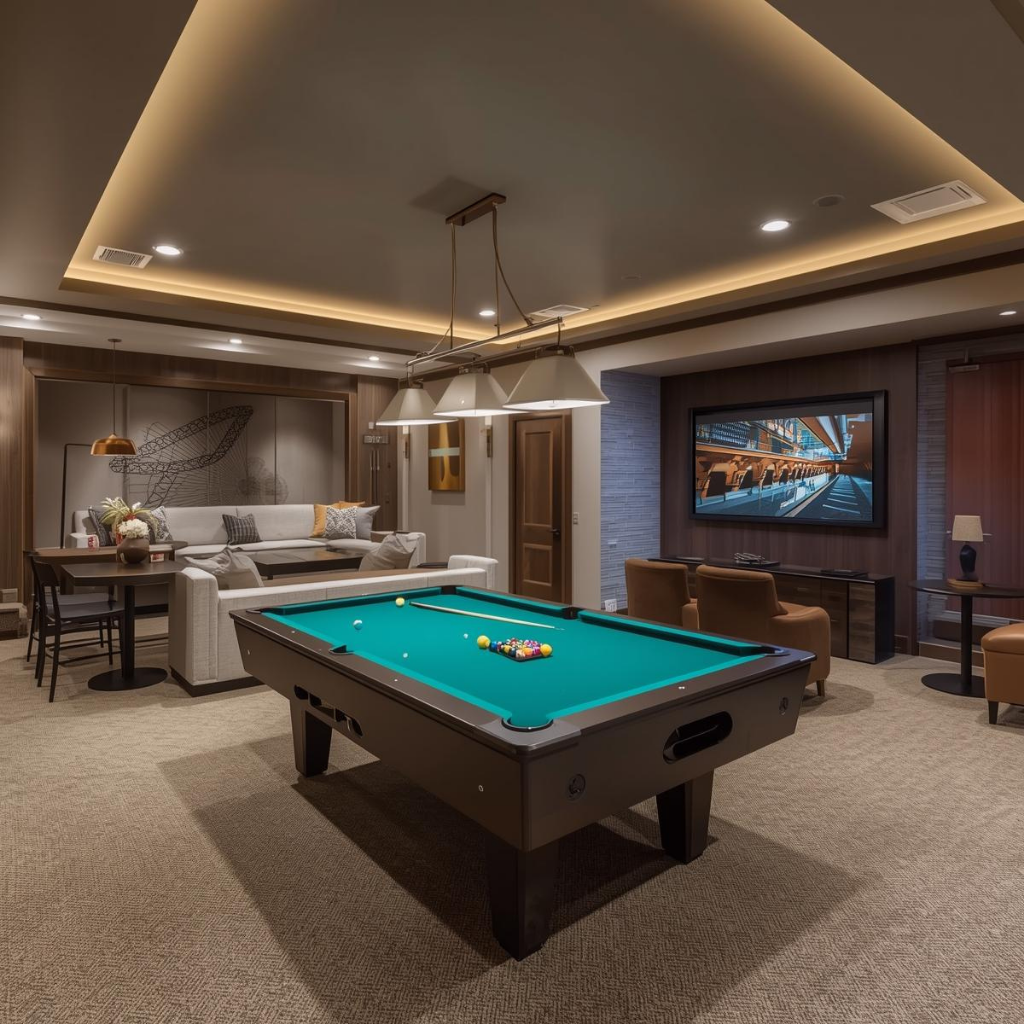
Real example: A Des Moines family with 750 square feet chose hybrid layout—open 450-square-foot entertainment area plus enclosed 200-square-foot guest bedroom and 100-square-foot bathroom. Total: $24,500.
Planning Around Structural Elements
Support Posts: Can’t be removed. Use as room dividers, wrap with storage ($200-800 per post), or incorporate into furniture placement.
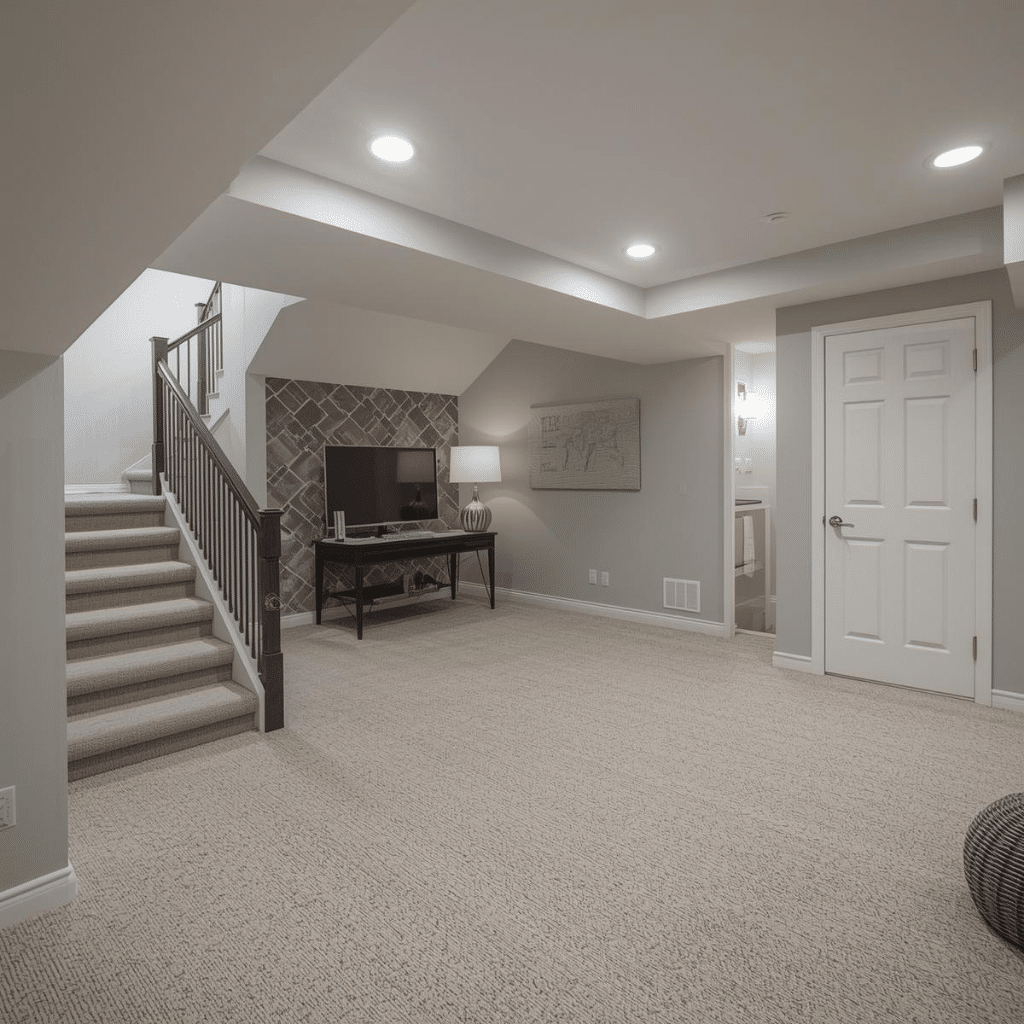
Stairs: Occupy 40-60 square feet. Utilize space underneath with built-in storage ($500-2,000) or powder room.
Mechanical Systems: Create dedicated utility closet. Relocating costs $3,000-8,000 (rarely worth it).
Ductwork and Pipes: Box in ($15-30 per linear foot), paint to match ceiling, or incorporate into drop ceiling design.
Creating Functional Zones
| Zone Type | Ideal Size | Cost Range |
|---|---|---|
| Entertainment | 150-300 sq ft | $2,000-6,000 |
| Home Office | 60-100 sq ft | $800-2,500 |
| Guest Bedroom | 100-150 sq ft | $5,000-12,000 |
| Fitness Area | 100-200 sq ft | $1,500-5,000 |
| Storage | 50-150 sq ft | $500-3,000 |
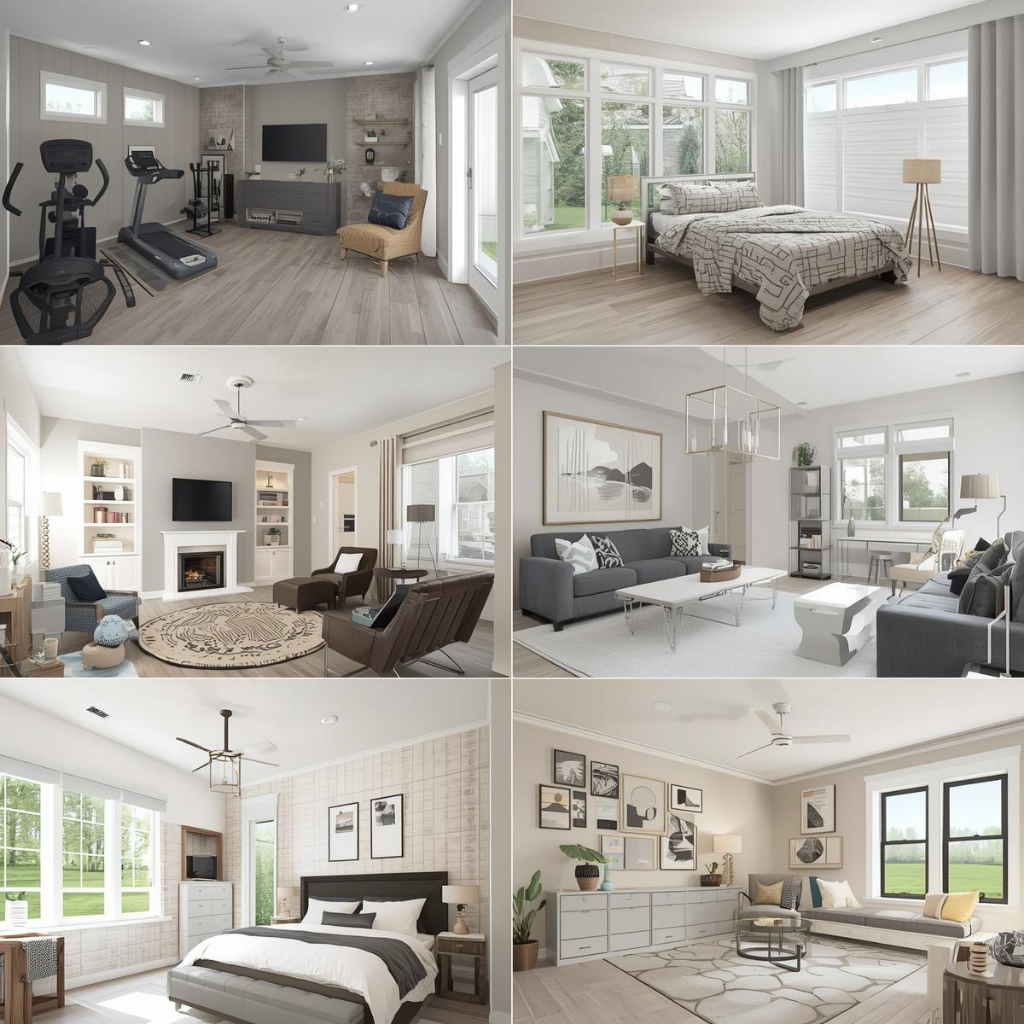
Multi-purpose zones save 30-40% space: home office + guest room (Murphy bed), entertainment + fitness (movable equipment), or kids’ play + craft area (fold-away tables).
Real example: An Ankeny couple with 650 square feet created open 300-square-foot entertainment zone, 100-square-foot office (doubles as craft space), 150-square-foot fitness zone, and 100-square-foot storage. Smart zoning made 650 square feet function like 900+ square feet.
Multi-Functional Design Strategies
Space-Saving Furniture:
- Murphy beds: $1,200-3,000 (saves 15-20 sq ft)
- Sofa beds: $600-2,000 (saves 20-30 sq ft)
- Storage ottomans: $150-500 (saves 5-8 sq ft)
- Wall-mounted fold-down desks: $200-800 (saves 10-15 sq ft)
- Modular sectionals: $1,200-4,000 (reconfigurable)
Real example: A West Des Moines family furnished their 500-square-foot basement with Murphy bed with desk ($2,200), storage ottoman ($350), fold-down craft table ($400), and modular sectional ($2,600). Total: $5,550 provided office, guest room, craft space, and entertainment area.
Strategic Storage Solutions
Vertical Storage Maximization
Using wall height saves 30-40% floor space:
- Floor-to-ceiling shelving: $1,000-3,000
- Wall-mounted cabinets: $1,500-4,000
- Floating shelves: $200-600 per wall
- Tall storage units: $300-1,200 each
Storage height strategy:
- Top shelves (7+ feet): Seasonal items, rarely-used
- Eye level (4-6 feet): Frequently accessed items
- Lower shelves (0-2 feet): Heavy items, bulk storage
Under-Stair Storage
Don’t waste triangular stair space:
- Pull-out drawer system: $800-2,000
- Fixed shelving: $400-1,000
- Cabinet enclosure: $1,200-3,000
Real example: A Waukee homeowner installed pull-out drawers under stairs ($1,400) storing toys, games, and seasonal items. This freed up 40 square feet of floor space.
Organizational Systems
- Clear storage bins: $3-8 each
- Adjustable shelving: $150-400 per unit
- Labeled zones: Seasonal, sports, tools, memories
- Bin sizing: Large (20+ gallons), medium (10-15), small (5-8)
Material Choices That Optimize Space
Space-Efficient Insulation
- Spray foam: 2-4 inches, R-6 to R-7 per inch, $2-4/sq ft (saves 2-3 inches per wall)
- Rigid foam boards: 1-2 inches, R-5 to R-10 per inch, $1-2.50/sq ft
- Fiberglass batts: 3.5-6 inches, $0.40-1.50/sq ft (most space lost)
For 600-square-foot basement, spray foam versus fiberglass saves 32-48 square feet through thinner walls.
Recommendation: Use Energy Star certified insulation with the highest R-value per inch you can afford.
Flooring That Expands Perception
- Light-colored LVP: $2-4/sq ft (reflects light, feels 15-20% larger, waterproof)
- Polished concrete: $3-8/sq ft (modern, seamless)
- Engineered hardwood: $4-8/sq ft (warm, continuous grain)
Real example: A Des Moines family replaced dark carpet with light gray LVP ($1,800 DIY). Visitors consistently estimated the 700-square-foot space at 900+ square feet.
Ceiling Options
| Ceiling Type | Cost/Sq Ft | Height Lost | Best For |
|---|---|---|---|
| Painted exposed joists | $1-2 | 0 inches | Tall basements, industrial look |
| Drop ceiling tiles | $2-4 | 4-6 inches | Hidden mechanicals, acoustics |
| Drywall | $4-6 | 1-2 inches | Finished appearance |
Lighting Design for Spatial Perception
Proper lighting makes basements feel 20-30% larger.
Layered Lighting Approach
1. Ambient lighting: Recessed can lights ($15-40 each), 1 per 25-30 sq ft, $600-2,000 for 600 sq ft
2. Task lighting: Desk lamps ($40-150), under-cabinet strips ($25-60), $200-600 total
3. Accent lighting: LED strips ($15-50), spotlights ($30-80), $150-500 total
Strategic Placement
- Eliminate dark corners
- Light upper walls and ceilings (draws eyes up)
- Use uplights on posts and walls
- Under-stair lighting prevents dark void
Real example: Adding six recessed lights ($690) plus LED strips under stairs and behind TV ($120) made an 8-foot ceiling basement feel 25% larger.
Color and Design Psychology
Colors that expand space:
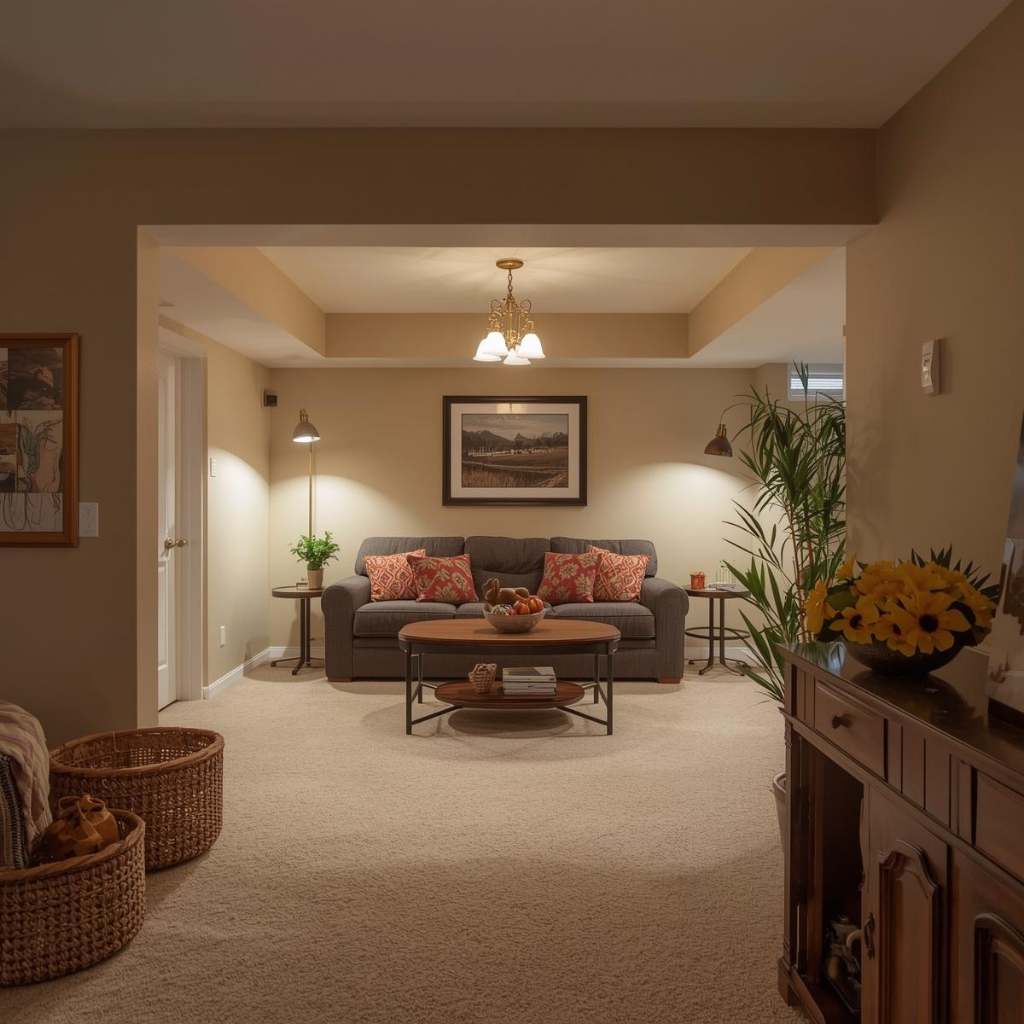
- Off-white, pale gray, soft beige, light blue, pale green
Colors that compress:
- Dark gray, navy, dark brown, bold red (reduce 15-20%)
Design elements:
- Mirrors: $50-300 each (reflect light, create depth)
- Minimalist: Less furniture = more spacious
- Vertical elements: Draw eyes upward
- Horizontal lines: Create width perception
Code Requirements and Space Implications
Understanding Iowa’s residential building codes is critical before planning your layout. These codes specify minimum ceiling heights, egress requirements, electrical standards, and plumbing guidelines that directly impact your space optimization strategy.
Essential Code Requirements
Ceiling Height: 7 feet minimum for habitable spaces
Egress Windows for Bedrooms: Minimum 5.7 sq ft opening, cost $2,500-5,000 each, occupies 15-20 sq ft wall space
Emergency Exits: Clear 36-inch pathway to stairs or egress
Permits: $150-400 in Des Moines for electrical, plumbing, structural work
Budget Planning for Space Optimization
Budget-Conscious ($8,000-15,000 for 600 sq ft):
- Open layout, basic materials, DIY work, simple lighting
- Gains 15-20% usable space
Mid-Range ($15,000-30,000 for 600-800 sq ft):
- Hybrid layout, professional installation, quality materials, built-in storage, layered lighting
- Gains 25-35% usable space
Premium ($30,000-50,000+ for 800-1,000 sq ft):
- Custom zoned layout, high-end materials, extensive built-ins, advanced lighting, full bathroom
- Gains 35-45% usable space
ROI of Space-Maximizing Features
| Feature | Cost | Space Gained | ROI at Resale |
|---|---|---|---|
| Professional space planning | $500-2,000 | 20-40% efficiency | 200-300% |
| Built-in storage | $1,500-3,000 | 15-30 sq ft | 60-80% |
| Under-stair storage | $600-2,000 | 20-40 sq ft | 70-90% |
| Lighting upgrade | $800-2,000 | 0 sq ft (perception) | 50-70% |
DIY vs. Professional Space Planning
DIY works for: Simple open layouts, small basements (under 600 sq ft), tight budgets Tools: RoomSketcher, graph paper, This Old House’s comprehensive basement guide
Hire professionals for: Complex layouts, structural work, large basements, maximizing resale value
Professional planning costs:
- Basic consultation: $200-500
- Design plans: $500-1,500
- Full design service: $1,500-5,000
Real example: A West Des Moines couple paid $600 for design consultation that revised their layout to include better storage and traffic flow—preventing a $3,000 mistake and adding functionality equivalent to 150+ square feet.
Working with Busy Builders for Space-Optimized Basements
At Busy Builders, space optimization is foundational to every basement finishing project. Since 2020, we’ve helped Des Moines area homeowners maximize basement potential through intelligent planning.
Our Process:
- Detailed assessment with precise measurements
- Custom layout design with 2-3 options
- 3D visualization (available for most projects)
- Material selection guidance
- Construction focused on maximizing space
Why Choose Us:
- Local expertise throughout Central Iowa
- Space maximization focus (increases functionality 20-40%)
- Realistic timelines and budgets
- Complete service from planning through final walkthrough
Frequently Asked Questions About Basement Space Maximization
How can I make my small basement feel larger?
Make small basements feel 20-40% larger through light-colored walls/flooring, open floor plan, proper lighting (6-8 recessed lights plus accents), vertical storage, strategic mirrors, and minimalist furniture. A 400-square-foot basement using these strategies can feel like 550-600 square feet.
What’s the best layout for a basement with support posts?
Design around posts by using them as natural room dividers, wrapping with storage/shelving ($300-800 per post), incorporating into furniture arrangements, or creating decorative columns ($200-600). Don’t fight structural elements—embrace them as space definers.
How much storage should I plan for my basement?
Plan 10-15% of total square footage for dedicated storage—60-120 square feet in a 600-800 square foot basement. Combine vertical storage (saves floor space), under-stair storage, and built-in solutions ($1,500-4,000) that utilize vertical wall area.
Should my basement have an open floor plan or separate rooms?
Open plans work best for basements under 600 square feet (feel larger), entertainment spaces, and maximizing light. Separate rooms work better for basements over 700 square feet, bedrooms (code requirement), and home offices needing quiet. Most 600-800 square foot basements use hybrid approach.
What lighting makes basements feel bigger?
Layer three types: ambient lighting (6-8 recessed can lights, $600-1,200), task lighting (desk lamps, under-cabinet strips, $200-400), and accent lighting (LED strips, $100-300). Eliminate dark corners. Proper lighting increases perceived space by 20-30%.
How much does professional basement space planning cost?
Professional space planning costs $500-2,000 depending on complexity. Basic consultation ($200-500) provides layout ideas. Design plans ($500-1,500) include measured drawings and specifications. Professional planning saves $2,000-5,000 by preventing mistakes and optimizes space 15-25% better than DIY.
Can I plan my basement layout myself?
Yes, for simple open layouts, small basements (under 600 sq ft), and if you have design research time. Use free tools like RoomSketcher or graph paper. Hire professionals for complex layouts, structural work, or when maximizing resale value. Hybrid approach—professional planning with DIY execution—works well.
What paint colors make basements look the most spacious?
Light neutrals expand space 15-25%: off-white, pale gray, soft beige, light blue, pale green. Avoid dark colors which compress space 15-20%: charcoal, navy, dark brown. Paint ceilings same color as walls or lighter. Use one accent wall maximum. Gloss finishes reflect more light.
How do I work around ductwork and pipes in my basement ceiling?
Handle ceiling mechanicals by boxing in and drywalling ($15-30/linear foot), painting everything the same color ($1-2/sq ft), incorporating into drop ceiling, or creating industrial look with exposed painted mechanicals (cheapest). Avoid moving ductwork ($2,000-6,000) unless necessary.
Should I hire a designer for my basement renovation?
Hire a designer if your basement is complex, you’re investing $25,000+, you lack experience, or want to maximize resale value. Designer fees ($500-5,000) typically return 3-10x value. Skip if basement is simple/open, budget is tight ($10,000-15,000), or you have design experience.
Key Takeaways
Strategic planning maximizes basement space by 20-40%
- Proper layout planning adds 100-300+ square feet of effective usable space
- Professional space planning ($500-2,000) prevents costly mistakes
- Open floor plans best for small basements; hybrid layouts for larger spaces
Multi-functional design multiplies functionality
- Murphy beds, sofa beds, convertible furniture save 15-30 square feet per room
- Multi-purpose zones provide functionality of 2-3 separate rooms in one space
- Strategic furniture increases usability 30-50% without expanding square footage
Storage solutions free up floor space
- Vertical storage saves 30-40% floor space versus horizontal storage ($1,000-3,000)
- Under-stair storage captures 20-40 square feet of wasted space ($600-2,000)
- Built-in storage maximizes odd spaces and increases home value 60-80% of cost
Lighting and color affect perceived space
- Proper lighting makes basements feel 20-30% larger ($800-2,500)
- Light-colored walls/flooring expand space perception 15-25% versus dark colors
- Recessed lights preserve ceiling height in 7-8 foot basements
Material choices impact usable square footage
- Space-efficient insulation saves 24-48 square feet in typical basement
- Light LVP or polished concrete creates spacious feel while being waterproof
- Painted exposed ceilings preserve maximum height
Iowa code requirements affect planning
- Minimum 7-foot ceiling height required
- Egress windows for bedrooms ($2,500-5,000) occupy 15-20 sq ft wall space
- Permits required ($150-400) with multiple inspections
Transform Your Basement Space Today
Maximizing your basement space requires thoughtful planning, smart material choices, and strategic design decisions before construction begins. Whether you’re working with 400 square feet or 1,200 square feet, these strategies help you create a basement that feels spacious, functions beautifully, and adds significant value to your Des Moines home.
Busy Builders specializes in space-optimized basement renovations throughout Central Iowa. Since 2020, we’ve helped homeowners transform cramped basements into spacious, highly functional living areas families actually use every day.
When you choose Busy Builders for your basement renovation project, you receive:
- Professional space planning included with every project
- Custom layout design with 2-3 options
- 3D visualization so you see your finished basement before building
- Space-efficient material recommendations
- Expert storage solutions utilizing vertical space and built-in options
- Complete code compliance for all Iowa building requirements
- Proven strategies from completing hundreds of Central Iowa projects
Ready to maximize your basement’s potential? 📞 Call: 844-435-9800 🌐 Visit: https://busybuildersiowa.com/ to schedule your free consultation. Let’s create a space plan that delivers 20-40% more functionality than you thought possible.
Busy Builders | Full Service Remodeling and Construction Done Right | Serving Central Iowa Since 2020