Composite Decking vs. Wood: Why Composite Wins
Iowa decks take a serious beating. Brutal winters, hot and humid summers, and freeze-thaw cycles that repeat dozens of times a year test every material you put outside. If you’re planning a deck in Central Iowa, your material choice matters far more than it does in milder climates. This guide breaks down the honest differences between composite and wood decking so you can pick the option that holds up, looks good, and fits your long-term budget.
TLDR: Composite decking costs more upfront, but it almost always wins on the long-term math. It handles Iowa’s freeze-thaw cycles better than wood, resists rot and pests without chemical treatments, and cuts out the annual sanding and sealing that wood demands. If you want a deck you can enjoy rather than maintain, composite is worth the extra investment. Read on for the full breakdown.
Why Your Decking Material Choice Matters in Iowa
You’re not building in a mild climate. Central Iowa sees temperature swings of over 100 degrees between seasons. Ground moisture freezes and thaws repeatedly through the winter. Summers bring humidity that accelerates mold and wood decay.
Both composite and wood can build a beautiful, functional deck. But they perform very differently over 10 to 20 years, especially here. The material you choose today affects how much you spend, how often you work on it, and how it looks a decade from now.
What Composite Decking Is Made Of
Composite decking combines recycled wood fibers and plastic polymers, pressed together under heat into dense, consistent boards. Most composite products include a protective outer shell that resists stains, fading, and scratching.
Many composite boards use a high percentage of recycled material, including reclaimed wood fibers and post-consumer plastics. That keeps waste out of landfills and reduces the demand for new timber.
What Wood Decking Options Exist
Pressure-treated lumber is the most common wood decking choice in Iowa. Manufacturers add chemical preservatives regulated by the EPA to slow rot and discourage insects. Cedar and redwood offer natural rot resistance as alternatives. Hardwoods like ipe are exceptionally durable but cost significantly more.
Every wood option requires ongoing care to stay structurally sound and attractive. That’s the central trade-off.
The table below gives you a quick side-by-side comparison of the two materials.
Here’s how composite and wood decking compare on the key decision factors:
| Feature | Composite | Pressure-Treated Wood |
|---|---|---|
| Upfront cost (installed) | Higher | Lower |
| Maintenance level | Low (soap and water) | High (seal, stain, sand every 2-3 years) |
| Typical lifespan | 25-30 years | 10-15 years with proper care |
| Splinter risk | None | Moderate to high as wood ages |
| Pest and rot resistance | Excellent | Moderate (depends on treatment) |
| Warranty coverage | Typically 20-30 years | Shorter, varies by supplier |
Costs vary by project. Always request a quote based on your specific deck size, layout, and feature list. Estimates vary by scope, materials, and complexity.
How Iowa’s Climate Affects Each Material
Iowa’s weather is the most important variable in this decision. Pay close attention to the freeze-thaw factor.
The Freeze-Thaw Problem for Wood
Wood absorbs moisture. When that moisture freezes, it expands inside the wood fibers. That repeated expansion and contraction causes cracking, warping, and splitting over time.
Sealing your wood deck slows this process, but it doesn’t stop it. Each Iowa winter chips away at unprotected or under-maintained wood decking. By year eight or ten, many wood decks show visible deterioration along the grain.
How Composite Holds Up
Composite decking resists moisture absorption because of its plastic component. Freeze-thaw cycles have far less impact on composite boards than on wood. The boards don’t swell, crack, or splinter from moisture penetration the way wood does. The USDA Forest Products Laboratory has conducted 20 years of research on the fungal and moisture durability of wood-plastic composites, confirming that properly manufactured composite deck boards resist the kind of decay that shortens wood deck lifespans.
Pro Tip: Even with composite decking, your posts and substructure still need to be set below Iowa’s frost line, which sits at 42 to 48 inches. The deck surface material is separate from the framing requirements. Your registered contractor handles this as part of proper installation.
The table below shows how both materials handle Iowa’s specific weather conditions.
| Iowa Weather Challenge | Composite | Pressure-Treated Wood |
|---|---|---|
| Freeze-thaw cycles | Excellent, resists moisture absorption | Poor without consistent sealing |
| Summer heat and UV | Good to excellent (varies by product line) | Fades and dries out without treatment |
| Humidity and mold risk | Excellent, won’t rot | Moderate, requires sealed surface |
| Heavy snow and ice | Handles well | Handles well if properly maintained |
Choosing the right product line matters too. Read through decking material options for Iowa homeowners before you commit to a specific brand.
Maintenance: Where Composite Pulls Ahead
Most homeowners who regret choosing wood don’t regret the look. They regret the maintenance. If your goal is a deck you can actually relax on, this section matters most.
What Wood Maintenance Requires
To keep a wood deck sound and attractive over the long haul, you’ll need to:
- Clean it thoroughly at least twice a year
- Sand rough surfaces every few years as the wood weathers
- Apply a sealant or stain every two to three years
- Inspect regularly for rot, soft spots, and insect damage
- Replace boards as they deteriorate
That adds up in both time and money. Supplies and labor for wood deck maintenance can run several hundred to a few thousand dollars per year, depending on size and condition.
What Composite Maintenance Requires
Composite decks need much less from you. Sweep off debris regularly and wash the surface with soap and water a few times a year. That’s the core maintenance routine for most composite products.
Some composite decks benefit from an occasional cleaning with a composite-specific cleaner for stubborn stains. Beyond that, no sanding, no sealing, and no annual refinishing.
Pro Tip: Keep leaves and debris from collecting between composite boards. Built-up organic material can cause surface staining over time, even on low-maintenance products.
| Maintenance Task | Composite | Wood |
|---|---|---|
| Basic cleaning | Soap and water, 2-3 times per year | Deep cleaning twice per year |
| Sanding | Not needed | Every 3-5 years |
| Sealing or staining | Not needed | Every 2-3 years |
| Board replacement | Rarely, if ever | As boards deteriorate |
For a deeper look at what seasonal care looks like across both material types, check out our seasonal deck care checklist.
The Long-Term Cost Picture
Composite costs more upfront. That’s the reality. But when you factor in 20 or more years of ownership, the math often shifts in composite’s favor.
Wood decks that aren’t well maintained deteriorate faster and may need full replacement years ahead of schedule. A decade of sanding, sealing, and board replacement can close the initial price gap significantly.
Illustrative scenario: A homeowner in West Des Moines builds a 400-square-foot composite deck. The upfront cost runs higher than a comparable pressure-treated wood deck. Over 15 years, though, they spend almost nothing on maintenance beyond occasional cleaning. A neighbor with a similar-sized wood deck spends several thousand dollars on sanding, staining, and board replacement during that same period. The composite deck also holds its appearance much better heading into a potential home sale.
For a full cost breakdown, see our guide on average deck building costs in Des Moines and our deck material cost comparison.
Pro Tip: When you compare quotes for composite vs. wood, ask your contractor for a rough 10-year maintenance estimate alongside the install price. That total-cost view helps you compare more accurately.
Aesthetics: Composite Has Caught Up
A common hesitation about composite decking is the look. Early composite products had a plastic, uniform appearance that turned many homeowners off. Modern composite has moved well past that.
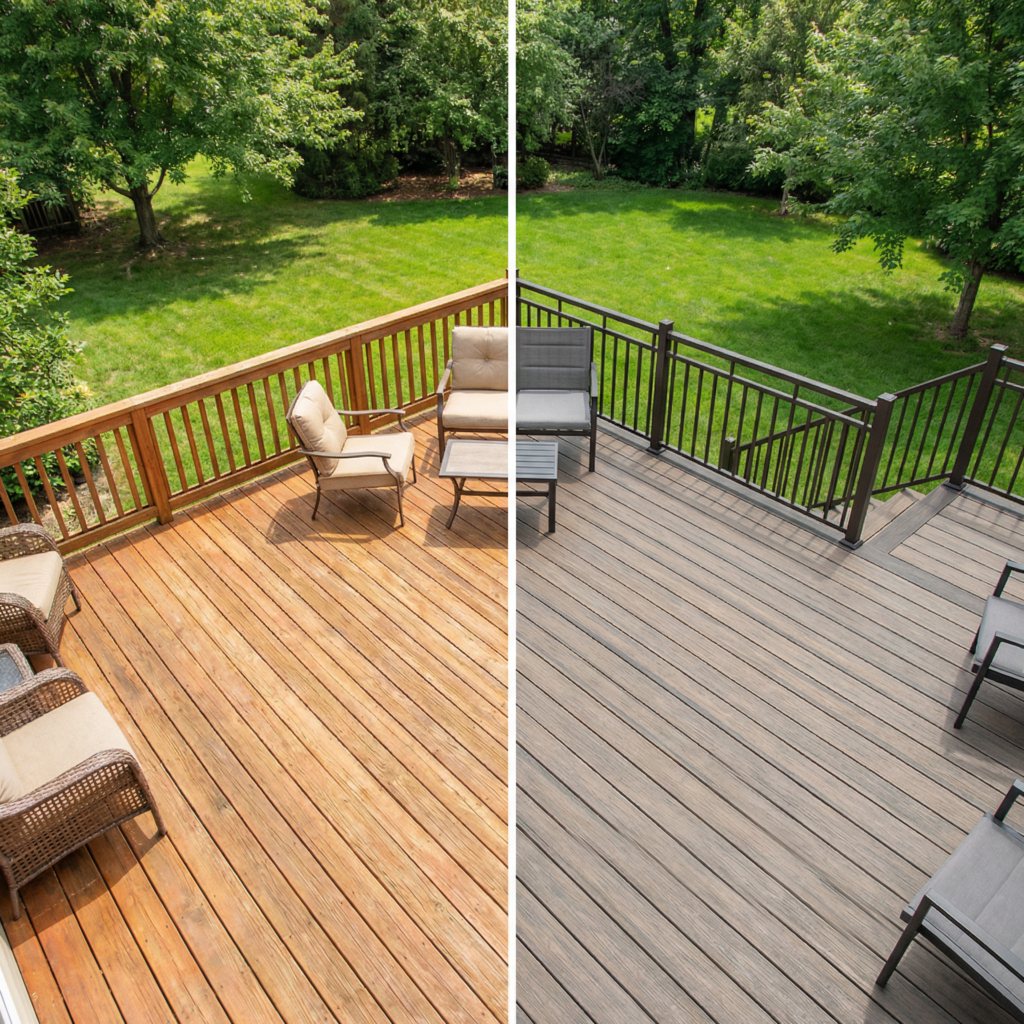
Today’s composite decking comes in dozens of colors and textures that closely mimic natural wood grain. Options exist that resemble cedar, teak, or even weathered barn wood. Unlike real wood, the color runs consistently across boards, so you avoid obvious variation between sections.
Some homeowners still prefer the warm, organic character of natural wood. That preference is fair. But if you want a beautiful deck without the upkeep, composite delivers.
Deck Building in Central Iowa: What to Know
Before you build, a few Iowa-specific facts are worth keeping in mind.
Permits are required in most Central Iowa cities. Des Moines and surrounding communities all require a building permit before deck construction starts. Your registered contractor typically handles this, but confirm before work begins.
Iowa requires contractor registration, not licensing. General contractors in Iowa must register with the Department of Inspections, Appeals, and Licensing (DIAL) if they earn $2,000 or more per year. This is separate from state licensing, which applies to electricians and plumbers. You can verify contractor registration at dial.iowa.gov. Iowa’s frost line sits at 42 to 48 inches. Deck posts must extend below that depth to prevent frost heave from shifting your structure. This requirement applies regardless of which surface material you choose.
Illustrative scenario: A family in Ankeny adds a 300-square-foot composite deck off their back door. Their registered contractor pulls the city permit, sets footings below the frost line, and installs composite decking boards rated for Iowa’s climate. Five years later, the deck still looks like new and has needed only basic cleaning.
Frequently Asked Questions
Q: How long does composite decking typically last in Iowa?
A: Most composite decking products carry warranties of 20 to 30 years. With proper installation and basic cleaning, many composite decks hold up well past 25 years. Iowa’s harsh winters are less damaging to composite than to wood because composite resists moisture absorption. Always check the warranty terms for your specific product before buying.
Q: Does composite decking get dangerously hot in Iowa summers?
A: Composite decking can get warmer than wood on hot, sunny days, especially in darker colors. Most homeowners manage this with shade structures or by choosing lighter-toned boards. Modern composite products have improved in this area, but it’s worth asking your contractor about specific product performance in direct sun.
Q: Is composite decking slippery when wet or icy?
A: Composite decking is generally less slippery than smooth-finished wood when wet because most boards have a textured surface. In icy conditions, both materials require caution. Using a plastic shovel for snow removal and avoiding sharp metal tools protects the composite surface from scratching.
Q: Can I install composite decking over an existing wood subframe?
A: In most cases, yes. If the existing wood substructure is in good condition, structurally sound, and properly spaced, composite boards can go directly on top. Your contractor should inspect the framing first. Composite boards have specific spacing requirements for airflow and expansion, so the existing joist layout must be compatible.
Q: Does a composite deck add value to a Central Iowa home?
A: Decks typically add value when selling, and composite decks often appeal more to buyers because they’re low-maintenance. According to the Remodeling Magazine Cost vs. Value Report, decks consistently rank among the better-performing home improvement investments for resale. Actual results vary by home, market, and deck condition, so treat any ROI figures as estimates rather than guarantees.
Q: What happens to treated wood chemicals over time?
A: Pressure-treated lumber uses chemical preservatives to resist rot and insects. The EPA provides guidance on preservative-treated wood products and their safe use around people and soil. Composite decking eliminates this concern entirely because it contains no chemical wood preservatives.
Q: How do I find the right composite decking product for Iowa’s climate?
A: Look for products rated for Climate Zone 5A conditions, which covers most of Central Iowa. Ask your contractor about brands proven to perform in freeze-thaw climates. The USDA Forest Products Laboratory maintains research on how different materials perform in varying climates if you want deeper technical information.
Q: Do I need a permit to build a deck in Central Iowa?
A: Yes, in almost every city in our service area. Most jurisdictions require a building permit for any deck that’s attached to the home or above a certain height. Permit requirements and fees vary by municipality. Your registered contractor should handle the permit application as part of the project. Always verify locally because building code requirements can change.
Key Takeaways
Material Performance
- Composite resists Iowa’s freeze-thaw cycles far better than wood
- Wood absorbs moisture and deteriorates faster without consistent maintenance
- Composite holds its color and surface condition much longer over time
Maintenance Realities
- Wood decks need sanding, sealing, and staining every 2-3 years
- Composite decks need only periodic cleaning with soap and water
- Skipping wood maintenance accelerates deterioration significantly
Long-Term Costs
- Composite costs more upfront but typically costs less over 15-20 years
- Wood maintenance costs narrow the initial price gap over time
- Always compare total 10-year cost, not just install price
Iowa-Specific Factors
- Frost line at 42-48 inches affects substructure, not just surface material
- Building permits are required in most Central Iowa cities
- Iowa general contractors must be DIAL-registered, not licensed
Decision Framework
- Choose composite if you want minimal upkeep and maximum durability
- Choose wood if upfront cost is the primary constraint and you’ll commit to maintenance
- Either material can build a beautiful deck when installed correctly
Ready to Build Your Deck in Central Iowa?
You now understand the real trade-offs between composite and wood decking. The next step is talking with a professional who knows Iowa’s climate, local permit requirements, and which products hold up best in this part of the country.
Busy Builders has helped over 1,000 Central Iowa homeowners build decks, finish basements, and remodel their homes since 2020. We bring honest guidance, accurate estimates, and registered crews to every project.
Here’s what we offer:
- Free consultation to discuss your deck goals and budget
- Honest material comparisons based on your specific situation
- Complete permit handling for your city or county
- Substructure set to Iowa frost line requirements
- Transparent pricing with no surprises
Call: 844-435-9800
We serve Des Moines, West Des Moines, Ankeny, Waukee, Urbandale, and all of Central Iowa. Schedule your free consultation today.
Busy Builders | Full-Service Construction and Remodeling | Serving Central Iowa Since 2020